

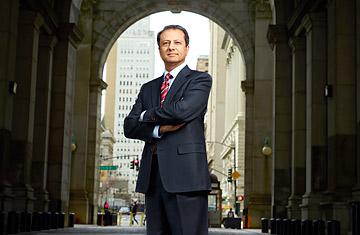
Preet Bharara, the US Attorney for the Southern District of New York, photographed on Sunday, January 29, 2012.
(6 of 6)
History shows a mixed record for forward-leaning prosecutors. Giuliani's highest-profile Wall Street target, Robert Freeman, served just four months in prison and paid a $1 million fine--for mail fraud. Appeals courts rolled back some of the honest-services-fraud convictions related to Enron and Conrad Black, and in 2005, the Supreme Court unanimously nullified the government's victory against Enron's accounting firm Arthur Andersen, a bitter end for the more than 25,000 employees who lost their jobs when the company folded in the wake of the lower court's 2002 conviction. Spitzer's civil suit to force New York Stock Exchange CEO Dick Grasso to return part of his multimillion-dollar pay package was drop-kicked by the appeals courts, as were other high-profile cases he brought on his way to the governor's mansion. Brendan Sullivan, the defense lawyer who successfully defended Alaska Senator Ted Stevens after his indictment on charges based on prosecutorial witness rigging, says we are at a historical extreme of prosecutorial power. "The pendulum has swung fully toward prosecutors," he says. "So it's all the more important that you have prosecutors with a keen sense of justice."
Sullivan is right, of course, and that's why warrants have to be okayed by judges. But it is also true that politics can sometimes drive prosecutions at every level of government, and there is a danger in wanting to criminalize the recession. The Obama Justice Department has launched a new wave of investigations of people behind the mortgage-lending free-for-all that nearly destroyed the economy when the housing bubble burst in 2007. Three years of prior investigations haven't yielded much criminal prosecution. Greed by itself isn't a crime. In trying to make Wall Street fairer to all investors, Bharara is in some respects acting as a regulator. Given the dithering in Congress over consumer financial protection, state and federal prosecutors get the job by default.
Bharara, who is not part of the new task force but says it is a "welcome addition," echoes Sullivan's call for prosecutorial standards. "In this office, we talk every day about doing what is right by the law and by our conscience and try to use the most aggressive technique that is appropriate to the task at hand, within limits of the law," he says.
That kind of talk explains why some friends say Bharara has the potential to become the first Indian American in a top spot at the Justice Department or in the courts. For now, though, Bharara says more insider-trading arrests are on the way, a statement he knows has its own power to deter potential criminals. "Securities fraud generally and insider trading in particular should be eminently deterrable crimes," he says. With Bharara on the beat, they are. But eventually Wall Street's appetite for making money will once again test the skills, and tactics, of America's prosecutors.