

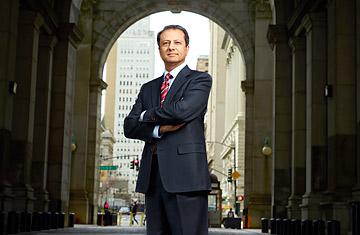
Preet Bharara, the US Attorney for the Southern District of New York, photographed on Sunday, January 29, 2012.
On wall street and in financial firms across America, the conference call is a standard workday tool. Traders, analysts and executives hop on to discuss trades, news and rumors that might move the market. Such was the case at the hedge fund Level Global Investors on Nov. 4, 2009, when one of its analysts joined a call organized by a second firm, Primary Global Research. PGR connects hedge funds, brokerages and other market players with executives of corporations--a Wall Street matchmaker of sorts--and on that day, PGR had some hot information for the hedgies at Level Global.
Too hot.
Unknown to the participants, Preet Bharara, U.S. Attorney for the Southern District of New York, was recording the conversation, and he wasn't looking for stock tips. A confidential informant had told his office that the party line was being used illegally to trade inside information. Bharara, who has launched a war on Wall Street crime, wanted proof. So he obtained a secret court order to join the conference call--something of a first for a U.S. Attorney. "Significant officials at publicly traded companies are casually and cavalierly engaged in insider trading," Bharara said on Jan. 24, sitting in his corner office behind Manhattan's city hall. "Because insider trading has as one of its elements communication, it doesn't take rocket science to realize it's nice to have the communication on tape."
Now Bharara is targeting an even more infamous Wall Street excess. On Feb. 1 he charged three former high-ranking Credit Suisse executives with fraud for inflating the value of mortgage bonds they held in 2008 in order to protect their bonuses as the housing market collapsed around them. Kareem Serageldin, head of the bank's structured-credit group, managing director David Higgs and Salmaan Siddiqui, a vice president in the investment-banking division, allegedly "papered over" more than $500 million in losses, according to the indictment, contributing to an eventual $2.65 billion write-down for Credit Suisse. Higgs and Siddiqui have pleaded guilty and are cooperating with the government. These are some of the first prosecutions of crimes involving residential-mortgage-backed securities, instruments that helped underwrite the housing bubble that led to the financial collapse.
In postmeltdown America, Main Street has been baying for some high-paid Wall Street heads to roll, and the 43-year-old Bharara is supplying them. His tactics are not always conventional. Prosecutors normally unravel criminal conspiracies one crook at a time, working their way slowly up the chain of command, and Bharara is doing some of that. But in an unusual and still controversial feat of prosecutorial moxie during his investigations of insider trading, Bharara and his team got a warrant to tap multiple people on the PGR conference call, beginning in early October 2009. The tap, which would cover 104 PGR employees and clients, gave Bharara a big net. The evidence that he and his staff would accumulate through that and other classic Mob-busting techniques like flipping lower-lever defendants into informants has led to the arrests of 63 people on insider-trading and other stock-fraud-related charges. Through pleas and at trial he's won 56 convictions--seven cases are pending--and he's had no losses.