

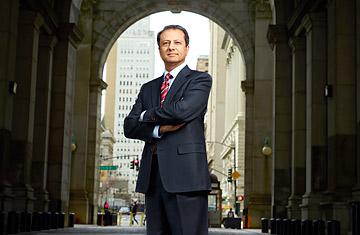
Preet Bharara, the US Attorney for the Southern District of New York, photographed on Sunday, January 29, 2012.
(5 of 6)
It was also in that job that Bharara learned the value of a wiretap. "When you're trying to make a racketeering case that involves charges of extortion, which by definition include threats of violence, and you have a guy saying, like you might see on The Sopranos, 'I'm going to staple your eyeball,' that's pretty good evidence. And you get that all the time," Bharara says.
In 2005 he showed he had political smarts, getting himself a job as a judiciary-committee aide to New York's senior Senator, Chuck Schumer. Bharara arrived in Washington a known quantity, thanks to his friendships with Republicans like Burck and Dinh, both of whom were already in the Bush Administration. That made him a trusted interlocutor between the Administration and the Democrats in Congress when accusations of political influence over prosecutors arose under then Attorney General Alberto Gonzales in 2006. Bharara became the lead investigator, uncovering political motivations behind the firing of nine U.S. Attorneys by top Gonzales aides. The investigation started the ball rolling that would eventually topple Gonzales and result in subpoenas against top White House officials, including Karl Rove and White House counsel Harriet Miers, and make Bharara's boss, Schumer, look good. In early 2009, Schumer encouraged newly elected President Obama to make Bharara the new U.S. Attorney in Manhattan.
Will His Perps Walk?
The Jury is still out on whether Bharara's war on this third wave of Wall Street crime will produce longer-lasting results than his predecessors' efforts did. Much depends on whether his convictions are upheld on appeal--and the defendants in these cases have the means to make the challenges that sometimes lead to reversals. The 1968 federal law on wiretaps explicitly limits the government's right to listen in on calls where there is no probable cause that a crime will be committed. And the definition of exactly what constitutes insider trading remains a hurdle. "Neither the SEC nor Congress has ever defined inside information, nor has either succeeded in specifying the level of significance the information must have to be the subject of a criminal violation," says Henry G. Manne, a dean emeritus of the George Mason University School of Law.
No prosecutor wins every case. While most of those overheard on the conference call who were charged with insider trading have pleaded guilty to securities fraud and conspiracy, at least one, PGR's James Fleishman, has not. "It should be tremendously scary for anyone who works in a large organization" that government prosecutors can tap conference-call lines that are used by multiple innocent people, says Ethan Balogh, the lawyer for Fleishman. Courts have been generous in judging whether a wiretap is reasonable, and Judge Jed Rakoff of New York's Southern District denied Balogh's motion to suppress the conference-call wiretap evidence and sentenced Fleishman to 30 months in prison. Fleishman is appealing to the U.S. Second Circuit Court of Appeals; the case could go all the way to the Supreme Court, thanks to the government's admission in its request for the tap that it didn't have probable cause against 93 of the 104 people it planned to eavesdrop on.