

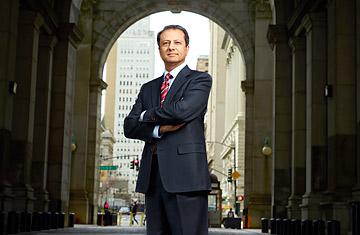
Preet Bharara, the US Attorney for the Southern District of New York, photographed on Sunday, January 29, 2012.
(4 of 6)
Over the months that followed, Bharara's team would mine the resulting wiretap warrant for all it was worth. On the Nov. 4, 2009, call, for example, Dan DeVore, a global supply manager for computer maker Dell who was paid in total more than $145,000 by PGR, told Spyridon "Sam" Adondakis of Level Global that computer sales had jumped from 60,000 units a day to as high as 200,000 units a day, thanks in part to the introduction of the new Windows 7 operating system. DeVore also gave Adondakis details on future pricing of Dell's computers. And he slipped Adondakis forecasts for the company's growth in coming months. All of this gave Adondakis a leg up on the market. DeVore briefed at least nine other analysts about Dell's prospects on the conference line over the next six months. When Bharara finally arrested him in December 2010, DeVore pleaded guilty to wire fraud and conspiracy and began cooperating with the government. It is a sign of how useful he is--and how much further Bharara plans to take this strand of his investigation--that DeVore's sentencing is not even scheduled until December 2013.
Giuliani says Bharara has chosen his cases wisely and well. "He's bringing responsible cases," Giuliani tells TIME. "When you make these high-profile prosecutions, you're deterring a lot of crimes."
Born to Prosecute
Bharara got to the Southern District from the ground up. He was born in the Punjab city of Ferozepur, where his father, a doctor, was struggling to raise a family. When Bharara was 2, his father brought the family to New Jersey via England, and Bharara remembers him drawing a contrast between how things worked in India and how they did in their new country. "I remember him talking about seeing bribes being passed, even among doctors [in India], which he thought was not the way it should work," Bharara says.
Bharara developed a first-generation immigrant's passion for the American way of government. In his first week at Harvard, he engaged in a now famous all-night argument with another newcomer, Viet Dinh, who later became a powerful lawyer in the George W. Bush Administration and an author of the Patriot Act. Dinh argued that the framers of the Constitution believed men's souls were evil, while Bharara insisted they thought they were good. By the time they went to breakfast the following morning, they were best friends. Back then, it was already clear to Dinh where Bharara was headed. "His unwavering focus has always been to become a prosecutor," Dinh says.
Seven years after Columbia Law School, Bharara got his chance, joining the Southern District, one of the largest, most powerful and most respected federal attorney's offices in the U.S. Assigned to the organized-crime unit, he teamed up with the agents busting figures from the Colombo and Gambino families. It was there, says his friend Bill Burck, a former deputy White House counsel for Bush who served with him as a prosecutor, that Bharara developed his signature mix of Ivy League training and wisecracking, blue collar casemaking.