

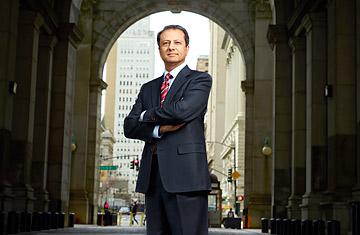
Preet Bharara, the US Attorney for the Southern District of New York, photographed on Sunday, January 29, 2012.
(3 of 6)
Bharara is the top cop on the beat at a time when Wall Street is experiencing its third major prosecution wave since the late 1980s. Giuliani made enough successful big-time busts during the first wave to launch a political career that culminated in a presidential run. His was the junk-bond era--marked by the crash of '87--when corporate takeovers fueled by "high yield" debt were frequent and inside information was a valued currency. He nailed Drexel Burnham Lambert's superstar banker Mike Milken and arbitrageur Ivan Boesky on charges related to insider trading. And he made drama a tool of his trade: the sight of Robert Freeman, the highly respected head of arbitrage at Goldman Sachs, being led away in handcuffs from the firm's trading floor was one of the most stunning scenes of the era.
New York Attorney General Eliot Spitzer was the star of the second wave, during the dotcom-bust days in the 2000s. Leveraging New York State's nominal jurisdiction over what usually are considered federal cases, he zeroed in on Wall Street's all-too-cozy relationships among investment bankers, analysts and firms' best customers in dispensing hot tech-stock IPOs. Spitzer also targeted the Street's research analysts' penchant for placing "buy" recommendations on every other piece of dotcom garbage their firms were taking public. During the same period, U.S. Attorneys in Houston took advantage of a relatively new law that made it a crime for corporate executives to deprive shareholders of "honest services." Down went Enron CEO Jeff Skilling and Hollinger's Conrad Black on honest-services fraud and other charges. Other big fish like WorldCom's Bernie Ebbers and Tyco's Dennis Kozlowski were also jailed.
There's a link between the Spitzer era and Bharara's current cases. Spitzer's spotlight helped prompt new regulations that forced the large financial firms to divest themselves of some in-house research capabilities to prevent collusion between research-chasing analysts and their stock-peddling colleagues. The idea was to strip the big brokerage firms of their access to inside info and give equal access to all investors. Instead, the activity was essentially outsourced to people who left the firms to set up their own research organizations--what would become known as expert networks--which then sold the information back to the Wall Street firms. Expert networks like PGR got good at penetrating corporations and connecting traders on the outside with corporate operatives on the inside who had useful information to sell.
What Bharara was listening for on the conference call in November 2009 was very specific: nonpublic information that could move stock prices. It is a violation of federal securities law to conspire to make money on "material nonpublic information," and in an FBI affidavit filed to U.S. District Judge Kevin Duffy, the feds claimed probable cause against at least eight of the potential 104 people who used the PGR line. Duffy granted the wiretap in early October 2009.