

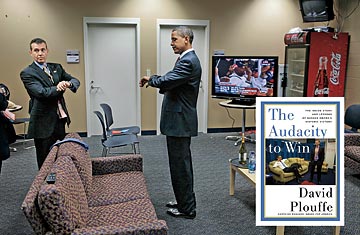
Plouffe, far left, with Obama in Denver on Aug. 28, 2008, the day the first-term Senator accepted the Democratic nomination.
(5 of 6)
"All of you on this call should watch video of her debates and speeches," Dunn counseled. "The substance is thin, but she's a very able performer. And her story is out of Hollywood. She'll be a phenomenon for a while."
Our strategy with the other potential picks would've been to start by saying that choice X subscribed to the same failed George Bush policies as John McCain; all they were doing was doubling down on the same out-of-touch economic policies that had hurt American families.
We should have gone the same way with Palin. But McCain had been haranguing us for months about experience, and we were incredulous that he had picked someone with zero foreign policy experience who had been a governor for less time than Obama had been a Senator. Galled by the hypocrisy, we moved in a more aggressive direction.
We decided to call McCain on the experience card directly. The value was in making him look political--essentially, calling him full of shit--and we sent out a release making that clear. "Today, John McCain put the former mayor of a town of 9,000 with zero foreign policy experience a heartbeat away from the presidency," it read. "Governor Palin shares John McCain's commitment to overturning Roe v. Wade, the agenda of Big Oil and continuing George Bush's failed economic policies--that's not the change we need; it's just more of the same."
Our statement immediately received an enormous amount of attention because it went right at her experience. The press clearly sensed heat and was eager to help drive the fight. Seeing the reaction, I began to think perhaps we had misfired. Obama clearly thought so. He called me from the air. "Listen, I just told this to Axelrod and [communications director Robert] Gibbs," he began. "I understand the argument you guys were trying to make. And maybe we should make it someday. But not today. We shouldn't have put out the first part of that statement. I want to put out another statement that simply welcomes her to the race, and I'll call her and congratulate her when I land."
I didn't disagree but thought backtracking would only add to the sense in the press that perhaps Palin was a brilliant game-changing pick that had scrambled the race. Even the famously disciplined Obama campaign can't get its story straight--this would be the blowback. "Look," I told him, "simply say that you're adding your own personal voice, one principal to another." He acknowledged that he understood and would watch his words. "We'll send out a personal statement from you and Biden," I said, "but it's important you not suggest we misfired on the original statement. Don't throw the campaign under the bus."
But when he took a few questions from the press later that day, he proceeded to drive the bus right over us. "I think that, you know, campaigns start getting these hair triggers, and the statement that Joe and I put out reflects our sentiments," he said. Great, I thought, already imagining the heat we'd take on this. But all in all, I felt solid about our instincts. Despite our clumsiness, I still thought we had nailed, in the predawn hours, what this pick would mean over time.