

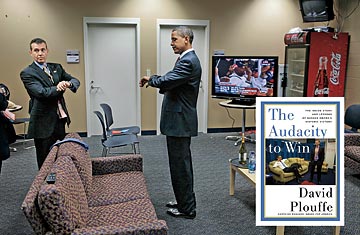
Plouffe, far left, with Obama in Denver on Aug. 28, 2008, the day the first-term Senator accepted the Democratic nomination.
(3 of 6)
We had initially received a lot of advice from many of her supporters to pick her, though this "advice" was perhaps more accurately described as subtle pressure. Their fervor was abating a bit every day, though, helped by Hillary's comments that this was Obama's decision and that he should be left to make it.
In early August, he narrowed his list down to three names: Senator Joe Biden of Delaware, Senator Evan Bayh of Indiana and Governor Tim Kaine of Virginia. Hillary did not make the last cut. At the end of the day, Obama decided that there were just too many complications outweighing the potential strengths. But I gave him a lot of credit for so seriously thinking about his fierce former rival. Some in the Clinton orbit thought we gave Hillary short shrift. My view is that any serious consideration was somewhat surprising given all the complications and the toxicity during the primary campaign.
Shortly before he took off for Hawaii and his much needed vacation, Obama asked Axelrod and me to meet with the three finalists. [We] pieced together a schedule that had us departing Chicago at 5:30 a.m. for Wilmington, Del., to meet with Biden; then on to West Virginia, where Bayh was vacationing with his family; and then to Virginia to meet with Kaine.
The [first] meeting started with Biden launching into a nearly 20-minute monologue that ranged from the strength of our campaign in Iowa ("I literally wouldn't have run if I knew the steamroller you guys would put together"); to his evolving views of Obama ("I wasn't sure about him in the beginning of the campaign, but I am now"); why he didn't want to be VP ("The last thing I should do is VP; after 36 years of being the top dog, it will be hard to be No. 2"); why he was a good choice ("But I would be a good soldier and could provide real value, domestically and internationally"); and everything else under the sun. Ax and I couldn't get a word in edgewise.
It confirmed what we suspected: this dog could not be taught new tricks. But the conversation also confirmed our positive assumptions: his firm grasp of issues, his blue collar sensibilities and the fact that while he would readily accept the VP slot if offered, he was not pining for it.
Later that day, we met with the two other finalists. Bayh's answers to our questions were substantively close to perfect, if cautiously so. Seeing Bayh right after Biden provided some interesting contrasts and comparisons. Listening to Bayh talk, I thought, There's no way this guy will color outside the lines. Biden may cross them with too much frequency. Biden will probably end up having more range--he can reach higher heights but could cause us real pain. Bayh's upside and downside are probably the closest spread of the three. As the day grew long, we headed to Richmond, our last stop. We appreciated [Kaine's] opening remarks. "I'd be honored to be picked," he told us. "But I have to assume I'm at the bottom of the list right now. I'll try to explain why I think I'd be a good pick, both for the campaign and after we win, but just know that I won't have an ounce of hard feelings or disappointment if I don't get picked. I signed on to this team in the beginning--all I want is for Barack to be elected President."