

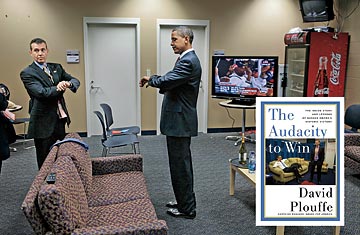
Plouffe, far left, with Obama in Denver on Aug. 28, 2008, the day the first-term Senator accepted the Democratic nomination.
(2 of 6)
"Tonight is Friday--well, Saturday morning," I said. "We have to give this speech no later than Tuesday. You have a full schedule in Pennsylvania the next three days. It has already been publicized. If we start canceling events, it will fuel the impression that we're panicked and our candidacy is on the rocks."
"No, we can't cancel anything," Obama interjected. "But I already know what I want to say in this speech. I've been thinking about it for almost 30 years. I'll call [lead campaign speechwriter Jon Favreau] in the morning and give him some initial guidance. And I'll work on this during downtime in the hotel room each night. Don't worry. Even if I have to pull all-nighters, I can make this work." We were flying by the seat of our pants. Somehow we had to keep faith that it would come together.
The speech received rave reviews from political commentators and spawned hundreds of positive editorials. More important, voters also responded very well to it. Wright still bothered them--but they respected how Obama dealt with the issue.
As was the case throughout the campaign, most people did not watch the speech on TV. It was delivered on a Tuesday morning, when just about everyone was at work. Instead, people watched it online, most of them on YouTube, either as it was happening or at their leisure later that day or in the days to come. Eventually, tens of millions of voters saw the speech through various outlets.
This marked a fundamental change in political coverage and message consumption, and one that will only continue as technology rolls forward: big moments, political or otherwise, will no longer be remembered by people as times when everyone gathered around TVs to watch a speech, press conference or other event. Increasingly, most of us will recall firing up the computer, searching for a video and watching it at home or at the office--or even on our cell phones.
Filling Out the Ticket
What surprised me at [our first meeting to discuss the vice presidency] was that Obama was clearly thinking more seriously about picking Hillary Clinton than Ax and I had realized. He said if his central criterion measured who could be the best VP, she had to be included in that list. She was competent, could help in Congress, would have international bona fides and had been through this before, albeit in a different role. He wanted to continue discussing her as we moved forward.
We met again a couple of weeks later in mid-June and winnowed the list down to about 10 names.
At our next meeting, we narrowed the list down to six. Barack continued to be intrigued by Hillary. "I still think Hillary has a lot of what I am looking for in a VP," he said to us. "Smarts, discipline, steadfastness. I think Bill may be too big a complication. If I picked her, my concern is that there would be more than two of us in the relationship."
Neither Ax nor I were fans of the Hillary option. We saw her obvious strengths, but we thought there were too many complications, both pre-election and postelection, should we be so fortunate as to win. Still, we were very careful not to object too forcefully. This needed to be his call.