

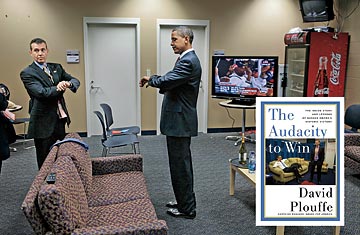
Plouffe, far left, with Obama in Denver on Aug. 28, 2008, the day the first-term Senator accepted the Democratic nomination.
(4 of 6)
There was no great way to explain putting someone with no foreign policy experience a heartbeat away from the presidency. If we chose him, we would need to rely on some of the same language we had used on this issue as it related to Obama--judgment vs. Washington experience, a new foreign policy vision vs. the status quo--but doubling down would make it twice as tough for us to roll this boulder uphill.
Later that night, we held a conference call with Obama to brief him on our day. "Well, it sounds like you both are for Biden, but barely," he said. "I really haven't settled this yet in my own mind. It's a coin toss now between Bayh and Biden, but Kaine is still a distinct possibility. I know the experience attack people will make if we pick him. But if that really concerned me, I wouldn't have run in the first place. My sense is--and you tell me if the research backs this up--that Barack Hussein Obama is change enough for people. I don't have to convince people with my VP selection that I am serious about change."
The selection of his vice-presidential nominee was his first presidential decision. On the evening of Aug. 17, he called Ax and me with the news. "I've decided," he said. "It's Biden."
Hurricane Sarah
We always knew this day was going to be a pain in the ass. Coming right off the exhaustion and exhilaration of our convention week and VP pick, we would have to jump right in and deal with theirs. But [Sarah] Palin was a bolt of lightning, a true surprise. She was such a long shot, I didn't even have her research file on my computer, as I did for the likely McCain picks. I started Googling her, refreshing my memory while I waited for our research to be sent.
Her story was original: small-town mayor takes on the Establishment and wins a governor's race; she was an avid hunter, sportswoman and athlete, and her husband was a champion snowmobiler; she had just given birth to a child with Down syndrome. A profile out of a novel, I thought.
But here she was, joining our real-life drama. And given her life story, coupled with the surprise nature of her selection, her entrance to the race would be nothing short of a phenomenon. But I also thought it was a downright bizarre, ill-considered and deeply puzzling choice. The one thing every voter knew about John McCain's campaign at this point was that it had been shouting from the rooftops that Barack Obama lacked the experience to be President.
With the Palin pick, he had completely undermined his core argument against us. Worse yet for McCain, he would look inherently political in doing so. His strength--and the threat he posed to us--was rooted in the fact that many independent voters believed in his maverick reputation and believed he did not make his decisions by prioritizing politics over what was right. I guessed people would view this choice more as a political stunt than a sound, reasoned call.
On our 6:00 a.m. conference call, [campaign adviser] Anita Dunn, who had worked against Palin in Alaska in the 2006 governor's race, warned us that she was a formidable political talent--clearly not up to this moment, she assured us, but bound to be a compelling player and a real headliner in the weeks ahead.