

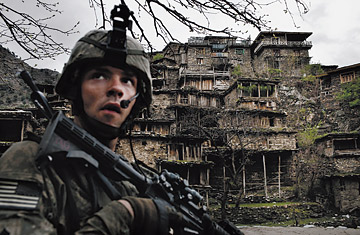
U.S. Sergeant Carl Baker of Bravo Company, 1-26 of the 1st Infantry Division, needs a sharp eye to protect his fellow soldiers as they meet with tribal leaders in the Afghan village of Loi Kolay
(5 of 5)
Obama has spoken of peeling away "moderate" Taliban members from extremists and reintegrating them into society. The easiest way to do that would be to provide opportunities and jobs. "It's not just about winning hearts and minds," says Ettore Francesco Sequi, the European Union's special representative to Afghanistan. "We also have to fill stomachs. That's the way we--and the Afghan government--will succeed."
But success in Afghanistan will mean nothing if fighters can find sanctuary in Pakistan. Commanders in Afghanistan say the battle next door will be far more complicated than anything they have seen, simply because the Pakistani military doesn't have the skills and resources to conduct an effective counterinsurgency. U.S.-operated Predator drones have successfully targeted al-Qaeda leadership in the border areas, but at the cost of inflaming the Pashtun-led insurgency on the Pakistan side. Stabilizing Afghanistan might well become crucial to preventing the far more terrifying prospect of an Islamist takeover in Pakistan. Says U.S. Army Brigadier General John Nicholson Jr., who commands U.S. and NATO troops in southern Afghanistan: "If the Pashtun population of Pakistan sees a moderate, Islamic and Pashtun-led government in Afghanistan, well, it's hard to argue with. So we have potentially a greater impact in Pakistan with success in the east."
That's one reason failure in Afghanistan is not an option. An Afghan businessman adds another. He lived through the resistance to the Soviets in the 1980s, only to see the U.S. abandon Afghanistan when they left. Another betrayal, he thinks, could produce the same blowback that helped lead to 9/11. "If Afghanistan is sold out again," he says, "you would be basically giving 60% of the nation into the hands of the people who want to destroy the West. And I can tell you that these young Afghans are ingenious, they are creative and they know how to use computers. I can guarantee you that they will find infiltration routes into the U.S. and Europe within four years. There won't be another chance for the West to get it right."
As the soldiers know, it's almost certain that getting it right now, after years of Western drift and inattention, will come at a heavy price in American money and lives. Having doubled down in the hopes of winning in Afghanistan, the Obama Administration has no choice but to live with the consequences.
A few days after the Loi Kolay mission, a bullet ripped through the thick morning fog blanketing a U.S. firebase perched on a ridge overlooking the village. The soldiers jumped to their firing positions, and squad leaders started shouting mortar coordinates into their radios. "I can't see s___," said one. "Where's it coming from?" Reports of more fire came in from another base and observation post. This was a coordinated attack; the dense clouds provided perfect cover. A new command came over the radio: "If you see anyone standing outside of a building, consider it hostile intent and fire at will." A vicious burst of gunfire echoed from below the post, silenced only by the roar of mortars hitting the insurgents' suspected positions. Then all was still. The thin, wavering sound of the call to prayer lifted from the village below. The soldiers could see nothing. They had no idea if they had been able to defeat their enemy or if he had simply disappeared back into the village he had come from.