

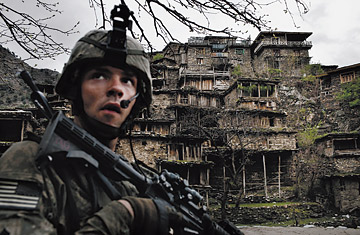
U.S. Sergeant Carl Baker of Bravo Company, 1-26 of the 1st Infantry Division, needs a sharp eye to protect his fellow soldiers as they meet with tribal leaders in the Afghan village of Loi Kolay
(4 of 5)
The Korengal shows why effective troops and police are needed. Lieutenant Burkey's evening operation to Loi Kolay was supposed to include a squad of Afghan soldiers. But at the last minute, the ANA commander pulled out, saying his men weren't up to it. Howell has seen that sort of thing before. "A lot of times, the ANA commanders want to do the bare minimum," he says. "It's frustrating because this is a way for them to start working with the elders, the community. If they can't make that connection, then we won't be able to hand security over to them." Many U.S. soldiers complain that the ANA simply isn't ready for the fight, that its soldiers are careless with their ammunition, often expending it all in the initial moments of battle. More training and better equipment will help, says Jenkinson. "I don't think the ANA is lacking the ability to fight the close fight. What they are lacking right now is air support, logistics and medevac abilities. If we were missing that kind of support, we wouldn't be going out either."
Why Jobs Are a Strategy Too
Long before the U.S. arrived in Afghanistan, the Korengal was relatively rich. It wasn't farming that sustained the area's residents; the rocky hillsides grow few crops. But a lucrative trade in the region's cedar forests funded satellite-TV dishes and fancy four-wheel-drive trucks. Local lore holds that the fight with the Americans began in earnest when the U.S., acting on a tip from a rival tribe, dropped a bomb on the lumber mill of a local chief, killing some of his relatives and leading to a campaign of vengeance.
The bomb coincided with a decision by the Karzai government, concerned about the environmental impact of clear-cutting, to ban timber exports outright. The valley's population lost its only source of income. Smuggling rings took over, bringing corruption in their wake. As it has elsewhere in Afghanistan, the national Taliban movement co-opted local grievances. (Taliban, these days, no longer refers just to the regime that once ruled the country; the word has become synonymous with any number of antigovernment forces.) Tribal elders say the fight in the Korengal is directed and funded by Gulbuddin Hekmatyar, a warlord who was once backed by the U.S. and has links to al-Qaeda. Nevertheless, says valley elder Sham Sher Khan, the way to counter the insurgency hasn't changed. He thinks reopening the timber trade would help. "The Taliban say they are fighting because there are Americans here and it's a jihad. But the fact is, they aren't fighting for religion. They are fighting for money," he says. "If they had jobs, they would stop fighting."
Is it really that simple? Afghans like Khan say only a small fraction of the insurgency consists of hardened jihadis willing to fight to the death; the rest are ordinary, poor villagers who simply haven't been given a better option. Khan estimates that the insurgents earn from $100 to $200 a month, money that comes from the illegal trade in lumber. Similarly, analysts in Afghanistan's south, where U.S. and coalition forces are fighting an insurgency funded by the opium trade, argue that the U.S. policy of poppy eradication has only fueled the fighting by eliminating income without providing an alternative.