

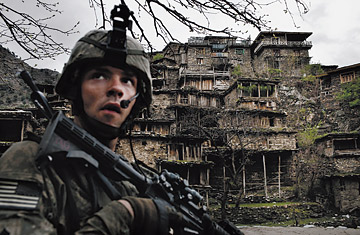
U.S. Sergeant Carl Baker of Bravo Company, 1-26 of the 1st Infantry Division, needs a sharp eye to protect his fellow soldiers as they meet with tribal leaders in the Afghan village of Loi Kolay
(3 of 5)
Here success cannot be measured in territory gained, schools built or clinics opened. Irrigation pipes and water pumps are blown up by the insurgents as soon as they are built. The road the villagers so desperately want has foundered, with construction forbidden by a Taliban edict that no one dares disobey. It's a good day in the Korengal when an elder slips an oblique warning that one of the observation posts might be attacked that evening. Sometimes progress is so slow it feels like a stalemate, admits company commander Captain James Howell. But, he says, "if we can reach a point where the villagers want to work with us and the Taliban are the only thing stopping them, that's success." Howell knows his company won't be able to tame the valley completely. He's not sure his successors will either. "To win this war," he says, "it's going to take patience."
Honest Infidels
Blindfolded and handcuffed, the man crouched on the ground, surrounded by Afghan soldiers and their U.S. Marine mentors. He had been found with insurgent propaganda and a Taliban flag and had a bruise on his shoulder--the kind the Afghan soldiers recognized from their days of carrying AK-47s while fighting Soviet forces more than 20 years ago. He said he was an illiterate shepherd, but he had a notebook full of writing. He claimed never to have visited Pakistan, but his mobile phone was filled with Pakistani numbers. Most likely, he was an insurgent. But the U.S. service members let him go. "You can't prosecute a guy for having a bruise," explains Howell. "We have to abide by rule of law." The village elders like to joke that the Americans may be infidels, but at least they are honest infidels. If a cow gets caught in a mortar attack, the soldiers pay for it. The hope, says Howell, is that such examples of transparency will eventually be emulated by local leaders. "The locals are justifiably frustrated with the corruption in their government. That has got to change."
Other than leading by example, the military can do little to bolster faith in the state. As part of his plan, Obama has proposed a civilian surge--a phalanx of mentors for the Afghans. Much of the more than $32 billion that the U.S. government has spent in aid to Afghanistan since 2002 has gone through the military or its provincial reconstruction teams. The projects are designed to earn goodwill for foreign forces as much as for local governors, but they also have the unintended consequence of undermining the central government, which never gets a chance to take credit for providing basic services such as roads, electricity and education. "We aren't here to win hearts and minds," says Jeremy Brenner, a U.S. State Department adviser based in Jalalabad. "What we need is to engender hope and faith in the Afghan government."
A government in which people have hope would be one that offers them security. The U.S. exit strategy for Afghanistan, according to Admiral Mike Mullen, Chairman of the Joint Chiefs of Staff, is to strengthen the Afghan forces so they can protect the fragile advances of the government. To that end, Obama has pledged 4,000 trainers and mentors, and European allies have promised more military trainers to help boost the Afghan National Army (ANA) and police.