

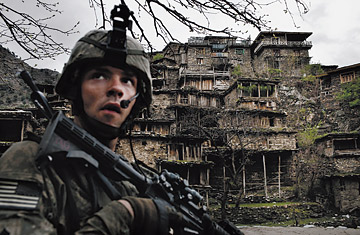
U.S. Sergeant Carl Baker of Bravo Company, 1-26 of the 1st Infantry Division, needs a sharp eye to protect his fellow soldiers as they meet with tribal leaders in the Afghan village of Loi Kolay
The soldiers crept into the village of Loi Kolay under the light of a crescent moon, slipping into defensive positions around a darkened house, gun sights trained on the rocky cliffs above. Four sharp knocks on the wooden door echoed through the silent valley. "Niazamuddin, we know you are in there!" the interpreter shouted. After a few tense moments, the tribal elder appeared. For months the village leaders of the Korengal Valley in Afghanistan's northeastern province of Kunar had complained about the U.S. and Afghan armies' searching of houses, a practice that went against tribal custom. Niazamuddin had suggested that he go along on the next search to help soften the impact. The U.S. soldiers were about to take him up on his offer.
Nobody was sure where Niazamuddin's loyalties lay. The local Afghan army commander was sure he was Taliban, though the U.S. commander wanted to give him the benefit of the doubt. If Niazamuddin was willing to lead a search, that would provide an example of solid leadership in a town riven by extremist sympathies. But Niazamuddin had gone back on his offer. If members of the Taliban found out he had led the Americans to suspicious houses, he said, they would kill him. The operation's leader, 1st Lieut. Glenn Burkey, exploded with frustration. U.S. forces had taken gunfire from the village several times, and previous house searches had turned up weapons, explosives and even a Taliban flag. Yet repeated raids risked alienating residents further. Burkey needed the elder's help. "You told us we had to do things differently," he said to Niazamuddin. "We are trying. I want the U.S. and Afghan forces to work together with the villagers to make this place safe." Niazamuddin was silent. "You remember Qadir?" he finally asked, naming his predecessor. "I don't know if he helped the U.S. or not, but the Taliban thought he did. They shot him coming out of the mosque." Then they beheaded his corpse in the public square.
The Valley of Death
Seven and a half years after U.S. troops arrived in Afghanistan following the attacks of Sept. 11, 2001, the war there is more deadly--and more muddled--than ever. When American troops first went to Afghanistan, they did so to overthrow the Taliban regime, which then ruled the nation and provided a haven for al-Qaeda. In less than three months, the Taliban was defeated, and a U.S.-supported administration, headed by President Hamid Karzai, was installed in Kabul. Yet in 2009, the U.S. is still fighting the Taliban, and al-Qaeda operatives are still plotting from Afghanistan. And one part of the region's deadly muddle has gotten worse. In 2001 there were fears that the war in Afghanistan would destabilize Pakistan. (The Pashtun ethnic group, which makes up a large part of the Taliban insurgency, straddles the border between the two countries.) Those fears are now reality; the Pakistani Taliban threatens nuclear-armed Pakistan's viability as a state even more than its cousins jeopardize Afghanistan's.