

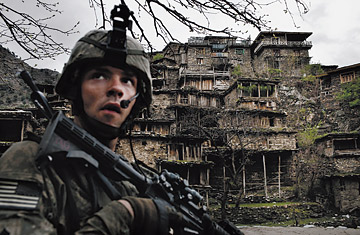
U.S. Sergeant Carl Baker of Bravo Company, 1-26 of the 1st Infantry Division, needs a sharp eye to protect his fellow soldiers as they meet with tribal leaders in the Afghan village of Loi Kolay
(2 of 5)
It is because the war in Afghanistan threatens to destabilize an entire region that it has become America's biggest foreign policy challenge. On Feb. 18, President Obama committed an additional 17,000 troops to Afghanistan; when they all arrive, there will be about 55,000 troops there from the U.S., plus 37,000 from its allies. The latest Afghan war is now Obama's war. The Administration has signaled that it is downsizing expectations about what can still be achieved: the principal goal now is to counter terrorism and bring a degree of stability to Afghanistan--not to turn a poor and fractious nation into a flourishing democratic state. When Obama laid out his new strategy last month, he made it clear that the mark of success would be the ability "to disrupt, dismantle and defeat al-Qaeda in Pakistan and Afghanistan and to prevent their return to either country in the future." But accomplishing even that comparatively limited objective at this stage will require a massive and sustained U.S. commitment--one that involves more than military boots on the ground. Al-Qaeda still thrives in the ungoverned tribal areas along the border between the two countries, and while many of its members have been killed, new recruits quickly take their place. U.S. soldiers have learned that to deny al-Qaeda a foothold in Afghanistan will require the establishment of a government that Afghans can believe in, the security that allows them to support it and jobs that provide an alternative to fighting. "We are not going to kill our way out of this war," says Lieut. Colonel Brett Jenkinson, commander of the U.S. battalion stationed in the Korengal Valley. "What we need is a better recruiting pitch for disaffected youth. You can't build hope with military might. You build it through development and good governance."
The experience of the Americans fighting in the Korengal Valley illustrates how difficult the war in Afghanistan is--but also how it can still be won. Over the past nine months, Bravo Company, a 150-strong unit of the 1st Battalion 26th Infantry Regiment, lost seven men in the Korengal while trying to cool down a toxic cauldron of local insurgents, Taliban leaders, foreign jihadis and al-Qaeda members that has some calling this cedar-studded gorge the "Valley of Death." The villages of Korengal have had their losses too, but they are deaths mourned in secret. Elders say the Americans haven't killed a single innocent. The villagers claim not to know those who are buried following bombing campaigns and mortar barrages. Yet every day, soldiers watch men leave the village and disappear into thick underbrush, only to emerge hours later to rain bullets down from their favored fighting positions. No one knows what--or who--lies at the end of the 6-mile-long (almost 10 km) valley because no one has been able to make it that far.