

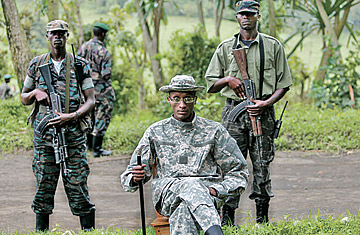
Nkunda pictured at his base surrounded by armed soldiers before his Jan. 22 capture by Rwandan authorities.
(5 of 6)
Just as troubling is a mandate requiring MONUC to reinforce state authority. That means MONUC trains former militiamen and introduces them to the ranks of the same Congolese army that lives by looting and commits war crimes on a daily basis. Crippling its ability to rise above this behavior, a small number of MONUC soldiers have engaged in the same kinds of sexual assaults practiced by the nastiest of Congo's armed groups, resulting in 40 being sent home, nine civilian staff members being charged and one more being sacked. MONUC is also investigating possible arms- and gold-trafficking by Pakistani soldiers. Tatiana Carayannis, a Congo expert at New York City's Social Science Research Council, concludes, "It's not quite hell, but we're at a turning point here. Congo could go either way, and it's really about what MONUC does."
It's also about what MONUC is. In addition to 3,000 extra troops, Doss persuaded the U.N. Security Council to expand MONUC's mandate to allow it to target the commercial drivers of the war: the trade in Congo's minerals, like gold, and the world's largest reserves of coltan, which is needed to make components for cell phones. He continues to argue for an even more muscular approach to enforcing peace. "When we make these statements, when we claim the responsibility to protect, we have to be careful that we have the means to match our mandate," he says. "You don't go to war with blue helmets and white tanks."
Talk of war is a long way from traditional peacekeeping. But it is a direct consequence of the open-ended nature of R2P, and it raises troubling questions. Where does the responsibility to protect end? Does it mean fighting a national army? Does it mean supplanting a national government? Does it mean accepting the large losses that would inevitably accompany intervention in Somalia--the site of the world's worst humanitarian crisis--or in totalitarian states like Burma? Doss insists there are limits to what he proposes. "We assist the national process. We do not replace it," he says. "We're not an army of occupation." But introducing a foreign combat force into Congo would cast doubt on whether such declarations are sincere.
Gareth Evans, a former Australian Foreign Minister who's now president of the International Crisis Group, has just published a book on R2P. If something proves difficult, "it doesn't mean you abandon it," he argues. Rather, you "reinforce and update" it. Initially, he says, that would mean sending more soldiers and money. Others wonder whether the U.N. is doing not too little but too much and is in danger of falling into the same trap as NATO in Afghanistan and the U.S. in Iraq: the more robust the mission, the harder it is to leave. Alex de Waal, program director at the Social Science Research Council, warns, "When you move to coercive peacekeeping, you're no longer neutral. You cannot expect to be treated above and beyond the conflict. You are part of it."