

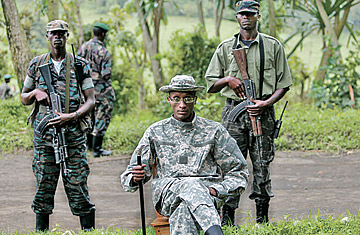
Nkunda pictured at his base surrounded by armed soldiers before his Jan. 22 capture by Rwandan authorities.
(4 of 6)
Word of that obligation does not seem to have reached Kiwanga. In one case last October, an elderly Spanish nun, Sister María, was caught in the cross fire between rebels and the Congolese army and became trapped under a falling wall. Still conscious, Sister María used her mobile phone to call Father George at a nearby Catholic mission. He contacted officials at MONUC and asked for an armored rescue but says they refused. A few hours later, the rebels carried Sister María to the front line. From there, a group of nuns took her to the Rutshuru hospital, where both her legs were amputated. The next day, Father George again asked MONUC to take Sister María to its base for an air evacuation. Again MONUC refused, and the nuns took her themselves once more. Almost 36 hours after the U.N. first learned of her being injured, a MONUC helicopter picked up Sister María and flew her the 10 minutes to Goma. "What is their point?" Father George says of MONUC. "They say they protect people, but they do nothing, nothing, nothing." Farther north, at Rwindi, I watched a group of Mai Mai child soldiers as young as 12 march unmolested past the gates of another MONUC base. Later, Dietrich said at the press conference in Goma that this column had been stopped.
We headed toward three towns where the Congolese army was fighting the Mai Mai. I arrived to find thousands of Congolese soldiers looting. Lines of men were carrying food, radios and clothes away. The army allows wives and children to accompany the men, and in the town of Karimba the soldiers slumped in the street, counting out their plunder with their families. In a courtyard off the main street lay the burned corpse of a young man. A second charred body lay outside, this one disemboweled, his yellow guts spilling across his navel. At the deserted town hospital, three soldiers sat unhappily with weak, malarial babies in their laps. The soldiers said they hadn't eaten in days.
An army colonel, John Tshibangu, arrived and promised that looters would be caught. A pastor, Rahera Kambale, pulled me aside. "Even as he's talking, they're still looting and raping and killing," he said. "This is the second time this month." I asked about MONUC. "They passed by one day," said the pastor. "They didn't stop." He echoed Father George: "I don't see their point." A few miles to the north, we found a Mai Mai checkpoint, where fighters searched a truckload of army wives, confiscating tubs of baby formula, bottles of Golden cooking oil and packs of Nice & Lovely face cream. Mai Mai leader Kissinger Kisamba is an army deserter. "This is my area," he said. "So I formed my own group to protect the people." MONUC, he added, "does not know the situation here."
When the Good Guys Go Bad
The day Sister María was injured, MONUC's compounds in Goma came under attack by mobs claiming that the peacekeeping force was doing nothing to protect them. Being set upon by the people it was sent to protect is a searing indictment of MONUC. "There is a huge amount of genuine frustration," admits Doss. "I understand it. I would be less than honest if I said we could guarantee the protection of every civilian."