

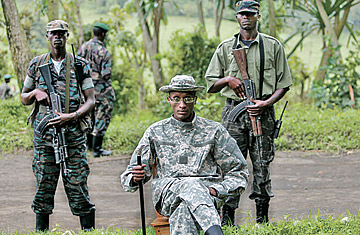
Nkunda pictured at his base surrounded by armed soldiers before his Jan. 22 capture by Rwandan authorities.
(3 of 6)
In late November, MONUC raised the threat level in Goma to 4 out of 5. Escorts of humanitarian convoys continued across North Kivu, but hundreds of soldiers had been pulled back to the city from 43 bases across the region, and patrols were largely limited to Goma and its immediate environs. The U.N. Security Council also granted MONUC 3,000 extra troops. Still, the force remained chronically overstretched. "Congo is the size of Western Europe, without roads," Doss says. Before he received his reinforcements, Doss had 10,000 soldiers in North and South Kivu protecting a combined population of 10 million from 40,000 to 50,000 armed men. In all of Congo, he had the same number of soldiers he had in 2003 as the U.N. special representative to Liberia, a country less than one-hundredth the size.
The day after entering Congo, I headed north toward the fighting. By 7 a.m., Goma's streets were jammed with blue helmets and white armored vehicles. The traffic ended abruptly on the edge of town. In the next four days, I did not see a single peacekeeping operation or, aside from two supply convoys, even a U.N. vehicle more than 500 yards (450 m) from a MONUC base.
Three miles (5 km) from town, I passed the last Congolese-army checkpoint and crossed the front line into rebel territory. Two hours later, at Kiwanga, where first Mai Mai and then Nkunda's advancing forces executed 50 to 100 young men on Nov. 5, thousands of refugees converged on a MONUC base, spooked by rumors of a Mai Mai counterattack. On their heads and wooden bicycles they carried mattresses, sacks of potatoes, children. The Indian soldiers at the base drove two armored personnel carriers 300 ft. (90 m) outside. They kept 30 more carriers, tanks, jeeps and trucks in neat lines behind the razor wire and limited their interaction with the crowd to shooing them off an adjacent helipad. The refugees built tents of sticks and rags in front of the gates. "Nobody ever gets into the base," said Meshaq Shebani, 22, a roadside diesel vendor. He eyed the rows of yellow and red flowers around a spot marked vip parking next to the commander's tent. "They don't protect us. They just sit there drinking tea."
Days later, at a press conference back in Goma, MONUC spokesman Lieut. Colonel Jean-Paul Dietrich described refugees huddling outside U.N. bases as a sign of public confidence. A reporter asked him how MONUC treats the wounded. "If people are injured, we take them to the base," he said. "That's the Geneva Convention."