

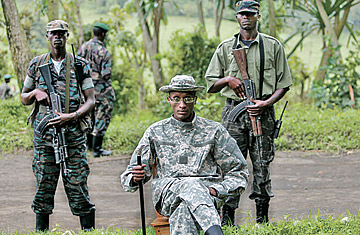
Nkunda pictured at his base surrounded by armed soldiers before his Jan. 22 capture by Rwandan authorities.
(2 of 6)
What the next stage of the conflict may be is impossible to guess. There are signs that forces loyal to Nkunda are melting away in the wake of his arrest. But that still leaves myriad armed groups who know only the way of war--and who continue to prey upon the people of eastern Congo. It was precisely to deal with such disasters--and with leaders like Kabila and Nkunda--that in 2005 the U.N. World Summit adopted a set of principles called the responsibility to protect, or R2P. Intended to prevent a repeat of cataclysms like the one in Rwanda, when the world watched but did little, R2P enshrines in international law the justification and obligation for intervention. A nation forfeits its sovereignty if it commits or is unable to prevent massive human-rights abuses on its soil. Should that happen, other nations can take action--using peaceful means such as diplomacy or sanctions or, if all else fails, military force--through the U.N. Security Council. Though the intent is not to replace a country's government, invoking R2P serves as a censure of it. Its message: You are doing an unacceptably poor job. We, the world, can and must do better.
That's the theory. It's pretty optimistic. It assumes that the world agrees on the primacy of human rights over national sovereignty and has the resolve to impose that consensus--another heady assumption--on the wayward few. "I don't know how the U.N. ever passed that resolution," says Anthony Holmes, head of the Africa program at the Council on Foreign Relations in New York City. "Maybe all the delegates had a great champagne reception before they signed, but I suspect that many of the countries that voted for it then would never vote for it again."
But even if you support the theory, there's the reality of implementing it. And to see that reality, Congo is the place to go. MONUC--the French acronym for the U.N. peacekeeping force of blue helmets and white vehicles in Congo--is the force tasked with getting R2P up and running. MONUC began work in 1999, years before R2P came into effect. But as the U.N.'s idea of peacekeeping evolved from deterrence and cease-fire-monitoring to peace-enforcing, so MONUC grew. It has the most aggressive peacekeeping mandate in U.N. history, one that includes "forcibly implementing" cease-fires and "using all means deemed necessary" to protect civilians and improve security. It is also supported by the world's largest peacekeeping force--20,000 soldiers from 18 countries--and funded by the biggest peacekeeping budget ever, an annual $1.1 billion.
But as Alan Doss, the U.N. special representative who is the MONUC boss, admits, MONUC is also something of a test of good intentions. "R2P is a huge step forward in terms of the principle of international humanitarian intervention," he says. "But the question remains: How do we actually do it?" A recent trip I made to eastern Congo suggests that question is not yet answered.
Threat Level 4
Congo is the land Rwanda left behind. At the border, the road turns from asphalt to mud and grit. Rwandan officials are famous for their incorruptibility, but Congolese immigration shook me down. Beyond lies the city of Goma, a sprawl of tin- and grass-roofed huts and refugee camps.