

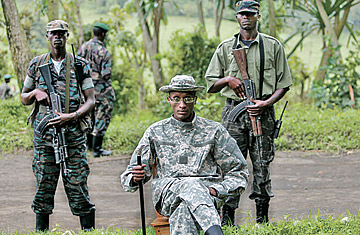
Nkunda pictured at his base surrounded by armed soldiers before his Jan. 22 capture by Rwandan authorities.
Drive west through Rwanda, threading past hills of eucalyptus, down to the shores of Lake Kivu and the Congolese border and you'll see real, actual signs of trouble. Every few hundred yards are hand-painted signboards marking the sites of massacres during Rwanda's 1994 genocide. Here, 532 were killed. There, 318. Here, "+/− 5,000." The word JENOSIDE is painted in scarlet, and after you've seen it--and the redness of the earth--a few times, it's hard not to wonder about the great flood of blood that bathed Rwanda when 800,000 people were slaughtered in three months. But there are other signs, signs of progress, indicating new hospitals and schools, and government-placed signs extolling a future of prosperity and public virtue: YES TO INVESTMENT. NO TO CORRUPTION. They indicate that Rwanda is moving on.
The eastern part of the Democratic Republic of Congo is not. The seeds of the humanitarian disaster now consuming it lie in the same Hutu-Tutsi hatred that engulfed Rwanda. The war in Congo began in 1994 when the Hutu militias--known as the Interahamwe--that carried out the Rwandan genocide were defeated by a Tutsi army and fled across the border, where they were pursued by their enemies. In that sense, the war in Congo took up where the one in Rwanda left off.
But the sequel has proved bigger, longer and immeasurably more complicated. The fighting is now in its 15th year. According to the International Rescue Committee, it has claimed the lives of 5.4 million people, mostly through the disease and malnutrition that have accompanied it. In 1998, the war sucked six countries into a smash-and-grab for Congo's minerals and timber. And it has spawned a plethora of new rebel groups, collectively known as the Mai Mai, founded on a mix of genuine tribal grievances and criminal and murderous intent. Everyone--the Mai Mai, the Congolese army, Hutu and Tutsi, Congolese and Rwandan--fights everyone else.
The latest chapter in the crisis began in October 2008 when Tutsi rebel leader Laurent Nkunda launched an offensive, taking advantage of the weak Congolese President, Joseph Kabila, and his collapsing army. Nkunda quickly doubled his territory in the province of North Kivu and threatened to march on the capital, Kinshasa. The U.N. says a quarter of North Kivu's 4 million people are now refugees as a result. "This is war" was Nkunda's explanation.
The fighting in eastern Congo is such a war of all against all, of alliances that shift by the week, that it is almost impossible for the outside world to keep up. The latest twist came on Jan. 20, when 4,000 Rwandan troops invaded once more, apparently with the acquiescence of the Congolese government. Two days later, Rwanda stunned observers--many of whom had thought Nkunda was a Rwandan proxy--by advancing on Nkunda's forces and arresting him.
Whose Responsibility?