

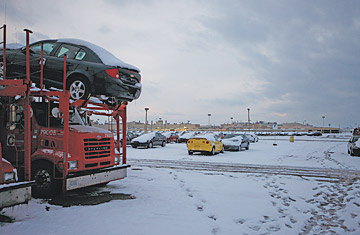
A GM plant in Lordstown, Ohio
(6 of 7)
As for GM, its current crop of autos, including the revived Malibu, is the strongest of the Detroit Three's fleets in North America, but it is still truck-heavy. Globally, GM is expanding in Russia and China; it is a solid performer in Europe and South America. With the advent of the Chevy Volt in 2010, the company will be in a position to lead the industry into hybrid-electric and then fully electric vehicles. "There's enough good product in the pipeline," says MacDuffie. "Judged against the past, it's really impressive."
The most important issue is cutting Detroit's output to an appropriate level. "What we would tell a client who went from 30% to 20% [share] and they say, 'We're modeling now at 20%,' I'd say, 'Let's model it at 16%,'" says Conway. Scaling below capacity doesn't mean you give up on 20% or even 22% share--you can add shifts, for instance, to boost output.
Reducing capacity could also go a long way toward solving Detroit's revenue problem. Between Detroit and the transplants, there are around 17 million units of manufacturing capacity in the U.S. In 2007 vehicle sales hit 16 million, but about 2 million of those were driven by the combination of easy credit and discount pricing. In a normal economy, the true size of the business may be closer to 15 million units. The Detroit Three simply have to generate more revenue per car and, not incidentally, a profit. Right now, the revenue gap per car is $4,000 vs. Toyota.
The competition hasn't stood still, of course. Japanese and German makers continue to improve their products, and the U.S. customers they have won over will be hard for the home team to get back. Even as the Big Three have closed the distance over manufacturing, drivetrain and other engineering issues, another has opened up. The transplants have moved on to the sensual: the quality of materials, the look and touch of dashboard knobs, the sound a door makes, the feel of seats. Craftsmanship is the new point of difference. "The Japanese have figured out, How do we reduce friction?" notes Gidwani. "Now they are going to have to catch them in a new area."
The real catch, though, is whether American taxpayers are willing to give the Big Three the chance.
Detroit-Three Math. Too many brands, not enough sales. How can they survive?
[This article contains a table. Please see hardcopy of magazine or PDF.]