

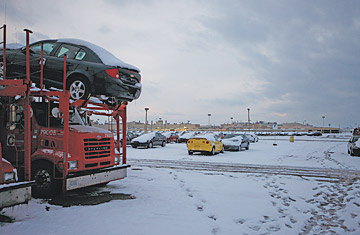
A GM plant in Lordstown, Ohio
(2 of 7)
Ford, which is in much better fiscal shape, asked for a standby credit line of $9 billion. The privately held Chrysler is going to need a $7 billion bridge loan, and it's willing to give equity to the government.
Importantly, all three companies promised to make money by 2012, even in a worst-case scenario of selling just 12 million cars and light trucks annually--4 million fewer than in 2007. The key is a revamped portfolio more heavily weighted to smaller cars and crossovers, as well as to hybrids and electrics that are far more efficient than the current fleet. That's crucial because Detroit currently loses money making cars in North America. You see the problem.
Most of these plans were on the drawing board before the global financial collapse made the situation more dire. This, in essence, is a last-chance opportunity. If Congress provides cover, the Detroit Three can try to rescale their manufacturing capacity to their respective market shares--or even below. GM, for instance, has lost 7 market-share points, falling to 22%, in the past 10 years. It plans to slash costs by an additional $7 billion by 2012. "It's all about survival," says Van Conway of Conway MacKenzie & Dunleavy, a crisis-management and turnaround firm in Birmingham, Mich.
Resizing the business will alter the number of nameplates that the Detroit Three market and the number of dealers that sell them. GM will sell or close Saturn. Pontiac and Saab could end up joining Oldsmobile and Plymouth in the hood-ornament graveyard because the cost of supporting a brand with a small market share doesn't make sense, nor does maintaining a dealership network created for an era when Chevy and Buick could support separate distribution systems. GM plans to reduce its dealer count 27%, to 4,700. "Certainly, having seven or eight brands for 25% of the market is far more than you need," says Ron Harbour, the partner in charge of consultancy Oliver Wyman's North American automotive practice.
The Detroit Three, in fact, may have to shrink to two. Chrysler, which burned through $3 billion in cash in its last quarter and has $6.1 billion left, is looking for more partners like Nissan, which is already contracted to build a small car for the company. Chrysler's owner--Cerberus Capital Management, a New York City private-equity firm--got a lemon when it bought 80% of the company from Daimler for $7.2 billion last year. A merger could be a way out.
End of an Era
No matter what congress or president Obama does, there is one aspect of the industry that is beyond rescue. The Detroit of the American Dream, the Benevolent Manufacturing State--the big-metal, Big Labor, big-brother, bigger-than-its-britches Detroit--is deader than Studebaker.
The Benevolent Manufacturing State was the self-funded, full-employment, womb-to-tomb society--for autoworkers, auto executives, their families and their communities--that Henry Ford began in 1914 when he hiked the prevailing $3-a-day wage to $5. "Fordism" outraged capitalists; Ford viewed it as a way to make cars affordable to working people. His people. The industry sputtered during the Depression, an era that gave rise to the unions, but was revived by wartime production as Detroit's manufacturing capacity became a vital weapon in the Allies' arsenal. Detroit reshaped America, spurring a great migration from the South with the prospect of fair employment for blacks.