

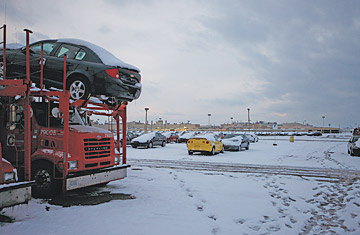
A GM plant in Lordstown, Ohio
(5 of 7)
The price of halfway restructurings was steep. In 1985, GM aped Japan's practice of building global cars--the idea was to share chassis and parts across brands, a strategy that made sense at the engineering level. At the consumer level, it was a disaster. Internal clashes for control removed imagination from design, resulting in look-alike Buicks, Oldsmobiles and Pontiacs. Sales declined; cue another restructuring. The Germans, who have their own auto culture, were no match for Chrysler after they bought the company in 1998. No wonder they gave it back.
Yet there were the occasional hits that demonstrated Detroit's deep pedigree in engineering and design. Chrysler, desperately surviving on a government-guaranteed loan, created the minivan in 1984. That same year, it launched the first modern sport-utility vehicle, the Jeep Cherokee. Throughout it all, Detroit kept its dominance of the hugely important pickup-truck market--and does so to this day.
But overall, if you build the cars you can make rather than the cars the public truly desires, you have to price them that way and use rebates to move the metal off the lots. "They are building cars that they don't want to build. They have to build them because they have a fixed cost structure to amortize," says Nick Gidwani, a former auto-industry investment banker with Sankaty Advisors and now head of the startup auto-sales website CarZen. Particularly after the post-9/11 sales slump, Detroit got addicted to this strategy and used it to move plenty of SUVs.
The ensuing rise in gas prices and drop in sales underscored another weakness. Although gas-eating SUVs found a sweet spot in the U.S., for Detroit to assume a world in which gas prices would remain below $2 a gal. was asinine. In Europe, gas had long sold for more than $5 a gal., and tax policy ensured that it would stay there; the growing BRIC countries--Brazil, Russia, India, China--were driving up demand. Detroit's response was to lobby furiously against increasing fuel-economy standards instead of building more-efficient SUVs.
What's Next
The irony about being called on the carpet in Washington is that Detroit actually has a fairly clear idea of where it's going. Ford, for instance, under the leadership of Alan Mulally, has rationalized the company, dumping Jaguar, Aston Martin, Land Rover and some of its stake in Mazda. Volvo may be next. "We have streamlined all of the brands to focus on Ford," he says. Ford wants to be able to create small- and medium-size cars around the world from a single global blueprint. The initial product of the One Ford strategy is the much anticipated Fiesta. It was designed in Europe and is due to arrive in the U.S. in late 2009 substantially unchanged. "Ford can win market share in small cars again," says Harbour. There's also a new Fusion and a new Taurus, long overdue, and upgrades to other models. As part of its 2006 strategy, called "The Way Forward," the company has already closed 17 plants and shucked 51,000 workers.
Chrysler is a bit of a mystery. CEO Robert Nardelli has been somewhat scant on details for new products other than announcing an electric-vehicle platform that has so far not impressed anybody. No one would be surprised if Cerberus, Chrysler's owner, announced some kind of partnership or merger before the year is out.