

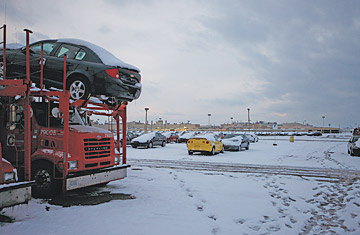
A GM plant in Lordstown, Ohio
"The American people made Ford Motor Company what it is. We have nothing the public did not give us. No surplus exists for personal benefit--every surplus is provided for future use. The future is here, and we are going to do our utmost--risk everything, if necessary--to use this surplus which the public, through its dealings with us, has provided, to see if we cannot make what the country needs most--work, jobs." --HENRY FORD, FEB. 11, 1932
This is the thanks you get for creating the middle class, Henry. In the throes of the biggest auto swoon since 1931, the headmen of Detroit go hat in hand to Washington to try to keep their once mighty industry upright for a couple of months and are treated as if they had invented the four-wheel-drive subprime mortgage. AIG torpedoes the entire economy and gets a $150 billion handout; Citigroup takes risks no sane manufacturing company would even contemplate and is rewarded with a $20 billion federal bailout. And the car guys?
The Detroit Three recently presented detailed restructuring plans to Congress--an application for loans and credit lines to tide them over until the economy rebounds. U.S. auto sales were down more than 30% in October--even Toyota wasn't spared. Detroit wants $34 billion to shelter 3 million jobs and $300 billion worth of business. The first time the companies came calling, on Nov. 19 and 20, Congress blew a radiator. "Even though all Americans want this industry to succeed, I cannot support a plan to spend taxpayer money to bail them out" is the way Spencer Bachus, the ranking Republican on the Committee on Financial Services, got the House hearings going. The incoming Administration is not holding out much hope that Congress can find a solution in the coming weeks. Instead, it is looking at what options--and pots of money--will be available once Barack Obama takes office.
What the CEOs of the Big Three have discovered is a nation suffering Detroit fatigue. Americans may not know squat about collateralized debt obligations, but as a nation we have been defined by car worship. We are angry at our car gods--who for too many years made too many clunkers--because we have owned the Dodge Aries K cars, Mercury Montereys and Chevy Chevettes they produced. So the citizens and the pols are irked to have to throw these companies a lifeline, even though they probably should do it for the good of the economy. An out-of-business GM (or even a bankrupt, reorganized one) is more than just a dead factory here and there. "There are real risks of cascading bankruptcy and then supply-side seizures," Columbia economist Jeffrey Sachs warned Congress, meaning that the ability of all car companies simply to make cars would be in jeopardy. The negative feedback in the supply chain would hurt partsmakers and dealers and even extend to retailers, restaurants and banks. But others argue that bankruptcy is exactly what GM needs, despite the dislocations.
GM, which is burning $2 billion a month, requested $18 billion in loans and credit lines--$4 billion for December. For that money, it will slash the number of plants it runs, the number of brands it makes and the number of dealers who sell them. It proposed cutting its hourly manufacturing costs in half. CEO Rick Wagoner agreed to work for $1 a year. GM's business is going down fast because consumers are already shying away from a potentially bankrupt company--which is part of GM's argument for immediate funding.