

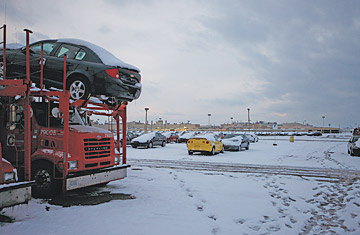
A GM plant in Lordstown, Ohio
(4 of 7)
Detroiters made the pilgrimage to Fremont en masse to see the miracle of NUMMI. Some dismissed what should have become a model for the entire industry. True, the technology wasn't that innovative. But Toyota had made the workforce integral to improving the system. Workers were not mere labor inputs. GM had no problem understanding the just-in-time inventory system Toyota used, but executing it required a buy-in from the shop floor so that everyone was dedicated to improvement. The Toyota system, says MacDuffie, "relies on contributions from employees. It feels vulnerable, but your willingness to be open to that vulnerability is what helps you make it work." In the 1980s and part of the '90s, the top-down culture of the Big Three could not absorb that kind of deep trust.
MIT senior lecturer Steven Spear, a lean-manufacturing specialist who has worked on production lines at both a Detroit Three and a Toyota plant, says the problem worsened over the years as products and manufacturing inevitably got more sophisticated. Merely upgrading a Toyota, he says, requires 300 man-years of engineering. No single manager can ever understand it. "Figuring out products, markets, customers, designs, systems--what's inherent about anything complex is that it becomes impossible. You can't design it perfectly," he says. What matters, he argues, is swarming problems from every direction to create high-speed, low-cost discovery and learning. And when you extend that open approach to suppliers, the path to lower-cost, better-functioning parts becomes easier too.
Management in a Mess
Detroit's corporate culture is obviously complicit in the industry's deterioration, just as it was guilty of creating an unparalleled manufacturing system decades earlier. The Detroit approach has been plan-command-control, stemming from that original control freak, Henry Ford. At GM, a management hierarchy that had been created by GM's master planner, Alfred P. Sloan, in the '20s--GM's first and most successful restructuring--was still functioning in the '80s. Management's job was to create the products, design the production system and provide solutions if there were problems. Everyone else followed orders.
Failing to cure themselves of the Not Invented Here disease, Detroit's bosses resorted to Hail Mary attempts to fix what were long-term issues. "They were constantly looking at buy, sell, hire, fire, looking to be rescued from their predicament," says Spear. On the buy side, GM CEO Roger Smith acquired Hughes Aircraft, EDS and a 50% stake in Saab. His successors bought the Hummer, 20% of Korea-owned Suzuki and 20% of Fiat with the obligation to buy it or pay to get rid of it. (The latter course was chosen, at a cost of $2 billion.)
Ford's owners have always had a difficult relationship with the hired help. Henry Ford II fired everybody, says Noel Tichy, a professor at the University of Michigan's business school--including Lee Iacocca. Jacques Nasser, named CEO in 1999 to reinvent Ford, bought Volvo and Land Rover to create a luxury portfolio; he saw Ford as more than an auto company and tried to overhaul the culture. He was ousted in 2001 by Bill Ford Jr.--great-grandson of Henry--who took back the wheel for a couple of years.