

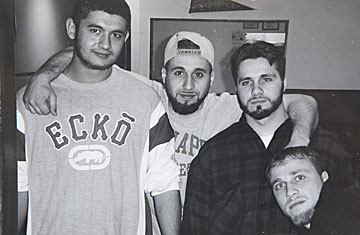
From left, Serdar Tatar and Dritan, Eljivir and Shain Duka are accused of being terrorists.
(5 of 5)
Pre-emptive prosecutions come with secondary risks. When they work, they may be more likely to put innocent people in jail--because they are built not around what men do but around what's in their hearts. When they don't work, when the jury won't buy the legitimate claims of a dodgy informant, dangerous people can go free. In San Francisco, the DEA lost a felony drug-trafficking case in October after the informant admitted to smoking crack during the investigation and then, on the witness stand, fell asleep--seven times.
The gravest consequence may be the long-term one: if the rumors of entrapment become so corrosive that no one in the Muslim-American community feels safe talking to the FBI, then the government has lost its best potential ally. While reporting this story, I met with a couple who had helped found the Sunni mosque attended by the Duka brothers. The couple had immigrated from India decades ago. We sat in their upscale suburban home and talked about the Dukas, whom they didn't know very well, and their fears. They were convinced that their phones were being tapped. They had stopped watching mainstream TV news and were even thinking of leaving the country. "This is a country which was great," the woman said. "That's why we all came--freedom of speech, justice, things that were not even to be found in Muslim countries. But it is vanishing every day."
In September, Mohamed Shnewer's 12-year-old sister was punched in the face and choked by a boy at her Cherry Hill middle school who called her a terrorist, her family says. Local police are investigating, and the girl has gone to Jordan with her mother. The family's store, along with the Tatars' pizzeria, has closed down because of lack of business, and the Shnewers have put their house up for sale. The Duka brothers' father was detained on immigration charges the day his sons were arrested; now he faces deportation.
In fact, the government could have just deported the Duka brothers at the beginning, dramatically reducing the expense and complications of the case. Since none of the men were known to have ties to any international terrorist organizations, they might have been a relatively low threat once deposited thousands of miles away. The NYPD is trying to pursue that alternative solution more often. (The NYPD intelligence unit also promotes officers for work that doesn't necessarily lead to arrests.)
But the pursuit of a traditional prosecution remains a powerful force at the Justice Department. It is hard to reward agents for walking away from cases. For now, terrorism expert Jenkins is comforted by one fact. "You do have an ultimate auditor against abuse or error, which is a judge and jury. It is up to them to look into the eyes of the informant and the defendants and decide who is telling the truth." Early next year, the Fort Dix defendants will have their chance. It will be as much a trial of their intent as it is of the government's new model--and of the informant Omar, who is expected to testify in depth.
Double Agents. The complicated characters inside several terrorism cases
[This article contains a table. Please see hardcopy or pdf.]
CASE INFORMANT BACKGROUND ROLE IN INVESTIGATION OUTCOME New York plot to bomb subway Osama Eldawoody Egyptian-born nuclear engineer Reportedly paid $100,000 to investigate prayer services in New York–area mosques; offered explosives to suspects and recorded conversations Shahawar Matin Siraj: received 30-year sentence for 2004 plot; James Elshafay pleaded guilty to conspiracy Plot at New York’s J.F.K. Airport (name unknown) Twice-convicted drug dealer Befriended suspect for payment and anticipated sentence reduction; accompanied suspect on multiple airport-surveillance trips and overseas meetings with other plotters Four men, originally from Guyana and Trinidad, have been charged with conspiring to blow up the airport’s jet-fuel supply tanks and pipelines; the case is ongoing Confession in Lodi, California Naseem Khan Pakistani American recruited by the FBI Paid more than $225,000 to pose as an extremist and record conversations with local Muslims Hamid Hayat convicted of providing material support to terrorists, giving false statements; 24-year sentence Attempted self-immolation at White House Mohamed Alanssi Yemen-born FBI informant His undercover work led to the conviction of a cleric who was funneling money to al-Qaeda; after his cover was blown, Alanssi spoke to the press Upset with the FBI at being unable to visit his family in Yemen, he attempted suicide by setting himself on fire in front of the White House in 2004