

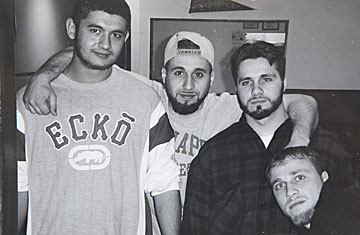
From left, Serdar Tatar and Dritan, Eljivir and Shain Duka are accused of being terrorists.
(3 of 5)
Omar went back to the Shnewer shop again and again. He made small talk with everyone, but especially with Mohamed, 22, a U.S. citizen and the Shnewers' only son. "Mohamed was like a baby," his mother Faten Shnewer says. He had dropped out of community college, and he lived at home. He liked to watch the Nickelodeon show Drake & Josh; play Madden, the football video game; and hang out with his five sisters. He worked long hours, often all night, driving a taxi owned by his father and talking by cell phone to his mother and his friends, the Duka brothers.
Soon Mohamed and Omar were playing billiards together and talking about politics, sports and religion. "He acted like a young guy, like he was cool and everything," says Hnan Shnewer, 16, who was Mohamed's sister and the wife of Eljvir. Through Mohamed, Omar met the Duka brothers and Serdar Tatar, another friend, who would be charged in the case.
At the time, Omar was on probation. In 2001, he had been charged with opening bank accounts, depositing bogus checks and then trying to draw down the account, according to the indictment. He had pleaded guilty to three counts of bank fraud and was sentenced to six months in prison and five years' probation and ordered to pay Patriot Bank $9,550 in restitution. Soon afterward, the Federal Government began removal proceedings against Omar, citing his conviction. He successfully fought the attempt. Then, in October 2004, Omar was arrested again, this time for fighting with a neighbor. After both men declined to testify, the charges were reduced to disorderly conduct.
In April 2006, just after Omar began working with the FBI on the Fort Dix case, the government tried to deport him yet again, according to the Department of Justice. Immigration officials declined to reveal any details about what led to that proceeding. But the record reflects that the case was closed in September 2006, which happened to be just after Omar recorded Shnewer saying some very provocative things about Fort Dix. The prosecutor has not yet confirmed Omar's name, let alone whether he received any kind of deal in exchange for his help. But it is clear that he was paid for his efforts--and that he needed the money. Omar filed for bankruptcy in New Jersey in 2002, at which point he owed about $38,000 to more than two dozen creditors. The prosecutor has not yet revealed how much Omar was paid, but it is probably well above $10,000.
Overheard at Dunkin' Donuts
There is an old saying among cops. "Good informant, good case; bad informant, bad case; no informant, no case," as Ronald Brooks, president of the National Narcotic Officers' Associations' Coalition, testified before the House Judiciary Committee in July. Informants are an excellent tool when they are meticulously supervised.
In the Fort Dix case, Omar was watched closely. "We felt fairly confident that we knew what was going on with these guys all the time," says U.S. Attorney Christie. There are more than 100 hours of recordings of Omar's conversations with the defendants. The month after Omar met Mohamed Shnewer, according to the complaint, Shnewer shared a DVD with Omar that allegedly contains jihadist recruitment messages. The next month Shnewer loaned Omar his laptop and told him to check out a file that appears to be the wills of at least two of the hijackers involved in 9/11, the complaint alleges.
Still, most of the recordings capture the normal, sometimes tedious chatter of young men. They drink coffee at Dunkin' Donuts and debate the merits of Ford vs. Chevy; they drink coffee and talk about their dismay over the war in Iraq; they drink coffee and talk about fishing. They play paintball and fire guns at snowballs lofted into the air. "I like to joke with these guys that they're like Albanian rednecks," says Michael Riley, attorney for Shain. There is something about the men's behavior that seems like that of kids at play. "It's like they were pretending," says Dritan's attorney, Huff. "The challenge will be to convince a jury they weren't serious."
The most damning statements seem to have come from Mohamed Shnewer when he was alone with the informant. On Aug. 1, he allegedly told Omar, "If you want to do anything here, there is Fort Dix and I don't want to exaggerate, and I assure you that you can hit an American base very easily ... When you go to a military base, you need mortars and RPGs." Under the law, an informant must be a witness to the crime--not the instigator. Shnewer's use of the second person, you, suggests that he may have viewed the informant as the initiator. "I am at your services as you have more experience than me in military bases and in life," Shnewer says at one point. At other times, however, Shnewer sounds more assertive. Later, he and Omar traveled to Fort Dix and other military bases to conduct surveillance, the complaint says. "My intent is to hit a heavy concentration of soldiers," Shnewer says.
On the group's second trip to the Poconos, in February 2007, the FBI was watching. When the Duka brothers went to a public firearms range, undercover agents and video cameras monitored their activities. By then, the FBI had also introduced a second paid informant--a good way to double-check on the first informant. The recordings made by this man, an ethnic Albanian like the Dukas, have not been made public, but he seems to have played a less significant role than Omar.
Tape-recorder malfunction
The government admits that Omar once gave his handler false information in order to protect a friend, according to the complaint. It was a one-time lapse, the complaint says, and Omar "has proven to be credible and reliable." But there are other red flags. "Clearly the informant had the opportunity to activate and deactivate the recording device," says Rocco Cipparone Jr., defense attorney for Mohamed Shnewer, according to his knowledge of the evidence so far. If that is true, it raises questions about how closely the informant was supervised. (The U.S. Attorney's office declined to comment on the claim, citing the impending trial.) In addition, the informants' recording devices--which may have been embedded in cell phones or some other nondescript location--malfunctioned multiple times during the investigation, according to defense attorneys who have seen transcripts of the conversations. While some malfunctions are understandable, they can be a sign that the informant was censoring his conversations.