

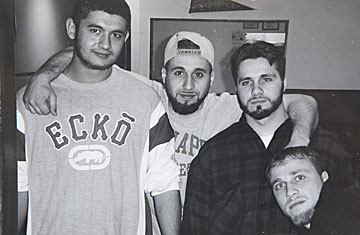
From left, Serdar Tatar and Dritan, Eljivir and Shain Duka are accused of being terrorists.
(4 of 5)
Context is everything in these recordings. For example, the complaint says Omar once asked Shain if he was "with them." In response, Shain said, "God willing, we will see." We don't yet know what was said before or after that. At another point, Dritan seemed stunned by a list of available weapons provided by Omar, saying "There was some stuff on the list that was heavy s___." The broader context will come out during the trial, and the defense attorneys are combing through the transcripts. "I get more confident the more stuff I read," says Troy Archie, attorney for Eljvir. "To me, it looks like they're using informants to rile these guys up."
Informants--and the baggage that often comes with them--are not new. They have become downright pedestrian in drug cases. For many convicts, cooperating is the best--and sometimes only--way to reduce a prison sentence. But the rise of informants has led to accusations that the government is outsourcing detective work to thugs. "The government's use of criminal informants is largely secretive, unregulated and unaccountable," Alexandra Natapoff, a professor at Loyola Law School, told the House Judiciary Committee last July. "Informants breed fabrication."
What is new is the heavy reliance on informants in terrorism cases. In drug cases, after all, no one usually gets arrested until someone actually has some drugs. Terrorism cases are harder. "If you send a source in, and he comes back with a kilo of cocaine, you're in pretty good shape," says the FBI's Cummings. "If I send a source into a terrorism operation, and he comes back and says, 'O.K., here's what these guys are planning,' then what do I have? Just the source's word. There's still plenty of work left to do to validate the source's reporting." Through recordings and the use of multiple informants, many agents carefully monitor their informants, but it's a constant challenge.
Again and again, accused terrorists have argued that they were entrapped. So far, this strategy has not worked very well. Legally, entrapment is difficult to prove. But in the Fort Dix case, the families of the defendants still insist they were tricked by Omar. Burim, the youngest Duka brother, says the first time he heard of any plot was from the informant. He says Omar asked him and his brother Eljvir if they wanted to participate, and they said no. Burim believes that Omar "brainwashed" Mohamed. A sixth defendant, Agron Abdullahu, pleaded guilty in October to conspiring to aid and abet the other men by loaning them guns. But he was never charged in the plan against Fort Dix, and he faces less than five years in prison. His attorney says he will not testify against the other men, since he was not aware of any plot.
Eleven months into the investigation, the complaint says, one of the defendants began to suspect Omar. Serdar Tatar, a legal resident from Turkey who worked at a 7-Eleven store and knew the Dukas and Shnewer from high school, asked Omar outright if he was a "fed." Three days later, Tatar contacted a Philadelphia police sergeant to report that someone was pressuring him to acquire maps of Fort Dix--and that he was afraid it might be terrorism-related. (Tatar's father owned a pizzeria and had a map of the base and clearance to deliver there.) The sergeant called the FBI.
Three weeks later, the FBI interviewed Tatar. At that point, he backtracked, the complaint says, denying any knowledge of a plot. It is not clear why the FBI waited three weeks to follow up with Tatar. By then, coincidentally or not, Tatar had succumbed to requests from Shnewer and the informant to hand over a map of Fort Dix, the complaint alleges. Tatar continues to deny giving him a map.
It's worth mentioning, of course, that it's not at all clear that the alleged plot would have succeeded. The base, which trains soldiers before they are deployed to Iraq, is heavily protected. Delivery vehicles are thoroughly searched before entry. But history shows that determined men don't need ingenious plans to be lethal. "Unfortunately, it's just not that hard to kill people," Homeland Security Secretary Michael Chertoff tells TIME. "People misunderstand what makes someone dangerous."
The map is important to the government's case since it could represent what is legally termed an "overt act." To prove a conspiracy, the prosecutor has to show that the defendants took concrete steps toward realizing the crime. A map might suggest tactical planning. And the government points to the alleged firearms and paintball training, as well as surveillance of targets, as overt acts.
But so far, court documents do not contain evidence of a specific date or detailed plan. Perhaps the most dire charges are that Shnewer and Dritan and Shain Duka wanted to buy fully automatic guns.
On May 7, 2007, Dritan and Shain went to Omar's apartment to buy the guns, the indictment alleges, including three AK-47 fully automatic machine guns, four M-16 fully automatic machine guns and four handguns. It's not clear from the evidence so far made public that they meant to use the weapons in an attack, but it is clear that those are some seriously frightening weapons.
When the brothers arrived at the informant's apartment complex, the police moved in. Minutes later, Eljvir was arrested when he came back from taking Dritan's kids to get ice cream. Shnewer was arrested while waiting for customers in the taxi line at Philadelphia International Airport. When he saw the police approaching, he joked to his fellow drivers, "See, when I hang out with you guys, you get me in trouble." Tatar was arrested at his Philadelphia apartment, where he lived with his wife. The informant, Omar, has vanished.
A cultural revolution
Since 9/11, the FBI and prosecutors say, they are more interested in gathering intelligence than in compiling the perfect prosecution. That attitude goes against their culture, which has always rewarded agents and lawyers for locking people up. "We have to run everything down. Everything is pursued, either preliminarily or we actually will open an investigation and throw a source in the middle of it," says Cummings, the FBI official. If the investigation comes up empty, it is closed, he says. "I don't have time to spend on garbage."
Sometimes, though, it seems as if the government is trying to do everything: gather intelligence, pre-empt a terrorist attack and send people to prison, even if the evidence is thin. Investigations seem to grow into case files, which lead to press conferences. "From the perspective of the investigators," says Jenkins, the Rand expert, "the more you invest in an investigation, you create your own momentum. You become convinced you've got a case."