

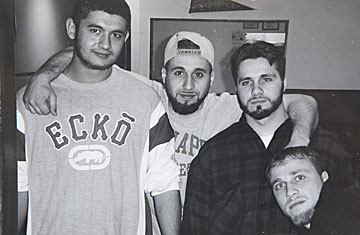
From left, Serdar Tatar and Dritan, Eljivir and Shain Duka are accused of being terrorists.
(2 of 5)
Most terrorism cases begin with a tip, sometimes a tip that turns out to be misleading. In Lodi, Calif., a town known as the "Zinfandel Capital of the World," a man told police he had seen al-Qaeda's No. 2 official, Ayman al-Zawahiri, in the area in the late 1990s. That astonishing claim turned out to be false. But soon the very same tipster was working for the FBI and recording his conversations with a local ice cream-truck driver and his son to see if they were dangerous. The tipster was paid more than $225,000 for his trouble, and after an exhaustive interrogation, the son admitted to authorities that he had attended a terrorism training camp in Pakistan. He was sentenced to 24 years in prison despite his lawyer's claims that the confession was coerced.
In the Fort Dix case, the Circuit City clerk's suspicion was reasonable. He had no experience with guns and thought what he had seen were illegal, fully automatic weapons (they were not). It made sense to be cautious. The police, too, did everything right. They saw what might or might not have been a sign of terrorism, and they took the tip seriously.
But the Circuit City video is far from conclusive. It features a group of friends and relatives vacationing in the Poconos in Pennsylvania and speaking mostly English. It includes shots of the men skiing, hiking and joking around, according to multiple people who have seen it. "I know how to burn DVDs," says Burim Duka, the youngest Duka brother, who had gone on the first Circuit City errand but has not been charged in the case. "We dropped it off because it's easier. We didn't think anything of it. If it was [a terrorism training video], why would I do that?"
Because of the high stakes, terrorism investigations can move forward on the basis of a few seemingly innocuous acts or even a single phrase. In the Circuit City video, the words jihad and Allahu Akbar (which means "God is great") are indeed uttered, according to multiple people who have seen it. But many devout and law-abiding Muslims use those words like punctuation marks, the way Christians might say, "Praise God" or "God bless." Says Burim: "We say 'Allahu Akbar' all the time. We mean it in the religious way. We used to think it was bad luck if we didn't say it before shooting."
It's clear that the men in the video liked guns. But what they claim was a hobby the government has termed a "militia-like" training exercise, because the men were, in some cases, walking or kneeling while shooting. This may be a sign of paramilitary training--or not. "We were going on our knees to get comfortable," says Burim, 16, who was also on the Poconos trip. "The guns are pretty heavy."
The critical question is, When does shooting guns or playing paintball (which the government has termed a "tactical training" exercise in this case) become nefarious? That is the subject of great debate among terrorism experts these days. "How do you decide when the line is crossed between a bunch of hotheads fantasizing and people actually planning attacks?" says Brian Michael Jenkins, a veteran terrorism expert at the Rand Corp. "The only way you can get at that is to have a good understanding of how this process works: What is the trajectory of self-identification, indoctrination, jihadization?"
Most homegrown terrorism plots are the work of "unremarkable" men, as a 2007 report on radicalization by the New York Police Department (NYPD) puts it, or "a group of guys," as U.S. intelligence officials call them. That's the best they can do, since the profile of a would-be terrorist is becoming less and less obvious. In that kind of fog, small behaviors necessarily loom large. In Australia, the NYPD report noted, before 17 men were arrested with bombmaking materials and maps of government buildings, some had traveled to the outback for a group bonding and hunting adventure. One month before the July 7, 2005, London transit bombings, two of the suicide bombers went white-water rafting together. Given these flickerings of a pattern, the Circuit City tape, which might have been ignored 10 years ago, set off a cascading series of actions. Each step led inexorably to the next, adding up to a multimillion-dollar case, which may have saved people's lives--or not. "That's the problem," says Michael N. Huff, attorney for Dritan. "The government does not have to wait. So you'll never know what would've happened."
Introducing the informant
After 9/11, it was painfully clear that the FBI lacked human intelligence. As agents began to develop Muslim informants, or "assets," as they are called, things changed. The number of informants used in terrorism investigations has "increased exponentially," says Art Cummings, deputy assistant director of counterterrorism at the FBI. That is a big improvement. But informants are not what most people think they are. They are not undercover FBI agents; they are untrained civilians who need something--badly. Usually, they need money or a way to reduce their prison sentences or avoid deportation. Many have criminal records, and the Justice Department's Inspector General reported in 2005 that 10% of a sampling of informants had committed new, unauthorized crimes while working for the FBI.
"Almost the first thing taught to agents is 'Never trust an informant,'" says Dennis G. Fitzgerald, a former agent with the Drug Enforcement Administration (DEA) and the author of a 2007 book, Informants and Undercover Investigations: A Practical Guide to Law, Policy and Practice. But out of necessity, informants are now foot soldiers in the government's fight against terrorism. The FBI has nowhere near enough agents who can pass as young Muslim extremists. "They need informants. Two FBI agents from Duluth are not going to make it," says Jenkins of Rand. So agents delegate the job to laypeople with strong and sometimes perverse incentives. "The only way to find out what's going on inside rather closed or private communities is to get people in there to infiltrate them," U.S. Attorney Christie tells TIME. "Would I rather have a trained law-enforcement officer as a witness? Yes. That's not always possible."
Mahmoud Omar was hired by the FBI to ingratiate himself with the men from the Circuit City video, and he did his job persistently if not always gracefully. In early 2006, Omar first visited a grocery store in southern New Jersey owned by Ibrahim Shnewer. The Shnewer family had immigrated to the U.S. from Jordan. Like Omar, they were Muslim. They were polite to Omar, who seemed needy for companionship and sometimes for money, according to members of the Shnewer and Duka families. He was a car dealer and a mechanic in his late 30s, and he claimed to have been a member of the Egyptian military. (Efforts to reach Omar, whose home number has been disconnected, were not successful.)