

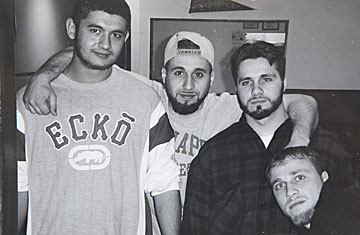
From left, Serdar Tatar and Dritan, Eljivir and Shain Duka are accused of being terrorists.
Mahmoud Omar is an informant. He plays the most important role in a terrorism case, yet one you never hear about. Like many informants, Omar worked against the government before he worked for it. In 2001, he pleaded guilty to three counts of bank fraud in Pennsylvania and went to jail for six months. In 2002, Omar, a legal immigrant from Egypt, declared bankruptcy. That same year, the U.S. government tried and failed to deport him. Two years later, Omar was arrested again--this time after he got into a fight with a neighbor. In 2006, the government again tried to deport him.
But that same year, the very same government put Omar on its payroll, and the immigration case quietly went away. Under the direction of the FBI, he infiltrated a group of friends in Cherry Hill, N.J., whom the government suspected of harboring terrorist intentions. For 16 months, Omar earned thousands of dollars recording hundreds of conversations. He drove one man to do surveillance of possible targets, according to court documents, and he offered to help buy illegal weapons for the group. Finally, in 2007, Omar handed over the men, thereafter known as the Fort Dix Six.
In May, when U.S. Attorney Christopher J. Christie announced their arrests on the steps of the courthouse in Camden, N.J., he called the Fort Dix case "the model for the post-September 11 era." He meant that as a compliment. Eight different law-enforcement outfits had cooperated, all following up on the tip of a concerned citizen. Six suspects were in jail, five charged with conspiring to kill soldiers at the Fort Dix military base in southern New Jersey and the sixth facing weapons charges. No one had gotten hurt. "This," said Christie, "is what we've been talking about developing since [9/11]."
A TIME investigation of the Fort Dix case shows that it is indeed an important prototype. Six years after 9/11, the U.S. government has begun to settle on a strategy for finding and stopping potential homegrown terrorists before they strike. Fort Dix offers a case study of this new and sometimes precarious method. The model is called pre-emptive prosecution, and like other pre-emptive strikes of late, it is risky. It means relying on often unreliable informants to infiltrate insular communities, and it means making arrests before anything close to a terrorist attack actually happens. The process sometimes ends with a trial but not necessarily a conviction, and that may be beside the point. It is, in all, a messy and unsatisfying ordeal, and possibly the best available option.
Suspicion in the suburbs
Cherry Hill is home to the first large indoor mall east of the Mississippi (built in 1961). Just four miles east of Philadelphia, the town is a crowded patch of box stores and neighborhoods. The parents of at least four of the defendants had moved to Cherry Hill from bigger cities to give their children a safe place to grow up in. Four of the six attended Cherry Hill High School West, and all are longtime friends. Three--Dritan, Shain and Eljvir Duka--are brothers.
In early 2006, the Duka brothers went to a local Circuit City to get an 8-mm video converted into a DVD. They were greeted by Brian Morgenstern, a clerk at the store who answered their questions about the cost of the service. "Everything was normal, really," says Morgenstern, a very serious 26-year-old with sideburns, bright blue eyes and two diamond stud earrings.
Dritan, Shain and Eljvir Duka are illegal immigrants from the former Yugoslavia, but they look and sound like Americans. They wear sports jerseys and speak with New York accents. The eldest, Dritan, arrived in the States when he was 5. He can't remember living anyplace else. When they were small, the Duka brothers worked as models in New York City. Eljvir appeared in a rock-music video, Dritan was an extra in Law & Order, and Shain was in a commercial for the World Wrestling Federation.
Several years ago, the three brothers, who had been raised Muslim but were not strictly observant, became much more religious, in part due to the influence of an uncle who has since been deported. They grew beards and stopped drinking alcohol. In religious, not legal proceedings, Dritan and Eljvir married 15-year-old Muslim girls. But they still played basketball, hung out at Dunkin' Donuts and, by all accounts, worked long hours at the roofing company they owned together. Dritan and his wife, Jennifer Marino, an Italian-American convert to Islam, had five children. (Eljvir's wife gave birth to a baby girl shortly after his arrest.)
It is, at this point, very hard to say how extreme the men had become in their beliefs. All the men charged in the conspiracy insist they are innocent. The trial is scheduled for March 2008, and the government has not yet made public its recordings of the defendants' conversations. But as Morgenstern remembers, if you saw the defendants at a strip mall in Jersey, you wouldn't look twice.
At Circuit City, Morgenstern copied the video out on the floor. He was paying no attention to the images flashing by until he glanced up and noticed bearded men in camouflage shooting guns and shouting in a foreign tongue. He took the tape to a back office and watched all 90 minutes of it. That night he went home and told his parents what he'd seen. Then he weighed what to do. What if this was nothing? he thought. What if I hurt people's lives when it was nothing?
The next day Morgenstern went back to Circuit City and called the police. They arrived within an hour. Two officers watched the video with Morgenstern, and when they heard the word jihad (which can refer to a holy war or a personal struggle of any kind), they said, "Stop it. That's enough." With that, the Fort Dix case file was opened. The officers made a copy of the video and left.
That afternoon the Duka brothers came back, picked up their DVD and left without incident. A week later the FBI showed up to get its copy. Morgenstern saw the Duka brothers only one more time. They came back shortly afterward with another tape to convert. But this one, Morgenstern says, was "everything I'm used to." It was a family video of kids and adults talking and laughing outside. And then Morgenstern heard nothing else for more than a year and a half.
Paintball interpreted