

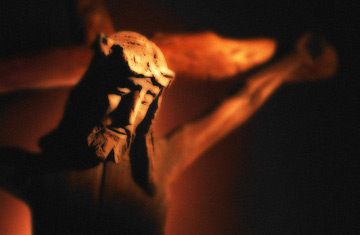
(9 of 12)
He'd grabbed a stout piece of rope from Hamer's, and he set straight to work. Throwing the rope up and over the strong limb, he started trying to recall the right knot--he mustn't fail at this too. But with all his years of studying scripture, he'd lost the knotting skills of his childhood on his father's scratch farm (Judas was the only one of the Twelve from outside the fishing villages of Galilee).
Maybe five minutes passed--he was sweating anyhow--when a man's voice spoke from close behind him. "Need any help?"
Judas lurched around, thinking the voice was too familiar. But the face was indescribably changed; Jesus' old fire and wit were gone. This man looked not remotely childish but utterly new, just born at sunrise, this April Sunday. So Judas said, "All the help I need--thanks anyhow--would be for you to leave."
The man almost seemed to leave for a moment; his image faded on Judas' eyes. Then he was back and stronger still. His face had the calm that Judas had spent a whole life hunting. The man nudged Judas lightly aside, then reached up and tied the appropriate knot.
Judas somehow watched the man's broad hands and still didn't notice.
But when the man finished, he raised both hands toward Judas and said, "Jude, go to your father now; he'll need you for the planting. The others won't harm you; I'll warn them off." The man's upright hands were pierced with deep wounds, just below the palms.
Judas' mind clenched down to the size of a pebble in his skull. But still he studied the new face for any further sign that this was Jesus, keeping his promise.
The strange head began to nod, signing Yes, and slowly a kind of mist around the eyes began clearing. Finally the voice said, "I've come to you first."
Judas never thought of fleeing. The one choice left apparently was to beg his teacher's pardon and then use the rope. So he asked the final question of all: "You're Jesus, aren't you?"
The head nodded Yes, though the eyes and mouth were entirely calm.
Judas said, "If you pardon me, help me leave then." He reached up and seized the rope in both hands. He'd need to climb the tree to make it work.
The man said, "I'll lift you." He did that with no strain at all, and he stood in reach of Judas' arms till the last breath failed, but Judas never once reached toward him.
That last invention is built on a claim in the Protogospel of James that Jesus was born in a cave in Bethlehem, and on a hint from the apostle Paul, who mentions that the risen Jesus appeared "to the Twelve," not the Eleven. None of the canonical Gospels, however, follow Paul's lead; yet the variety of their Resurrection stories is both convincing and unnerving. Most of them have a grainy credibility; at least one (Matthew's) seems generic and manufactured. Paul's account, in I Corinthians 15, was written some 25 years after Jesus' death and precedes Mark by perhaps a decade.