

(7 of 12)
The whole stretch of days in Jerusalem had gone badly wrong--the ass that went lame while bearing him toward the "triumphal entry," the vicious eyes and mouths around him through the Temple debates he sought so hungrily, and then his wild-eyed one-man assault on the money changers and lamb-and-dove merchants. Physically speaking, he'd done enough damage to last five minutes; but in terms of challenging the Temple mob, he'd laid the last straw on a big camel's back.
They were out to kill him now; it was in every eye that looked his way. Even eleven of the Twelve had realized Judas was the squealer, the one who'd sold the secret news that Jesus of Nazareth was God's Messiah--the coming King of the glorified Jews--and was here to proclaim it and greet the dawning of the reign he'd lead. And when Jesus took up the loaf and began to break pieces into a bowl, Judas got to his feet, hunched low and left the room.
As the bread came around, followed by the wine, Jesus said only, "My body...my blood." Good Jews that they were, a few nearly gagged at the thought of drinking blood, but no one refused. Practically speaking, he was already dead--they could almost see it--and everything from here on was only a sign, to keep in memory, everything but the craven fear that was already closing on them entirely.
IN THE GARDEN
The question about all three Gospel reports of Jesus' agony in the garden is this: If the disciples fell asleep, who heard and remembered Jesus' terrible prayer? My guess is only one of several practical possibilities. --R.P.
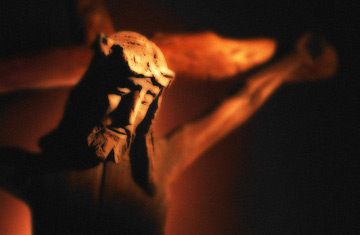
A half-hour later he'd led them back to the olive grove and the cave at Gethsemane where they'd been sleeping. Eight of them went straight in, dead beat, and stretched out on the floor near the oil press. But Jesus took Peter, James and John and pressed on a few yards into the dark grove. He asked the inner three to wait while he prayed. They were tired as the others, but they nodded that they'd wait, and he walked ahead some dozen paces to the oldest tree. It had half consumed one end of a table-shaped rock where he knelt.
They heard him say "Abba," which was any child's first name for Father. They'd heard him use it in private prayer a time or two, and John especially thought it was eerie and unbecoming. The God who was leading this man was no father tossing a child. By then Peter and James had dozed off, but John--being younger--managed to stay half awake through most of the prayer. He could hardly see Jesus, just flashes of his face when the moon broke clear, and then it was wrenched by an agony greater than the joy they'd seen when he came down toward them on Mount Hermon after his meeting with Moses and Elijah.
More than once John started to stand and go to him--whoever this despairing demon was, John could at least try the things he'd learned about demon expulsion. But then he'd catch a new glimpse of the face, and he'd stay where he was. Maybe this was no demon at all but the bitterest lesson Jesus must learn before the incomparably bitter cross--Jesus had told John more than once that a cross would stand near the end of his road. Now John heard one more thing, several times: "Let this cup pass. Abba, not this cup. But, sir, your will." Appalling as the transaction was, even John was asleep before it ended.