

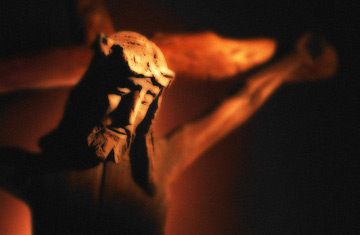
Editor's note: In a riveting exercise in biblical scholarship and storytelling, Reynolds Price translated the Greek texts of Mark and John, then wrote his own narrative in Three Gospels (1996). We asked Price, a prolific novelist (Kate Vaiden, the trilogy A Great Circle, Roxanna Slade and the forthcoming children's novel A Perfect Friend), to take another look at episodes in Jesus' life and craft a new Gospel based on the historical evidence and his reading of the Bible. He adds a chapter in which his erudition and imagination take a leap into an unexplored moment after Christ's Resurrection.
The memory of any stretch of years eventually resolves to a list of names, and one of the useful ways of recalling the past two millenniums is by listing the people who acquired great power. Muhammad, Catherine the Great, Marx, Gandhi, Hitler, Roosevelt, Stalin and Mao come quickly to mind. There's no question that each of those figures changed the lives of millions and evoked responses from worship through hatred.
It would require much exotic calculation, however, to deny that the single most powerful figure--not merely in these two millenniums but in all human history--has been Jesus of Nazareth. Not only is the prevalent system of denoting the years based on an erroneous 6th century calculation of the date of his birth, but a serious argument can be made that no one else's life has proved remotely as powerful and enduring as that of Jesus. It's an astonishing conclusion in light of the fact that Jesus was a man who lived a short life in a rural backwater of the Roman Empire, who died in agony as a convicted criminal, and who may never have intended so much as a small portion of the effects worked in his name.
Who was Jesus then? And how can we learn more about him?
We have little that might be called history concerning the man. There is a meager handful of unrevealing allusions to his existence in early Roman and Jewish sources. The recently recovered remains of a modest house in Capernaum give strong signs of being Peter's residence, which was apparently Jesus' Galilean headquarters. Ongoing excavations in Galilee clarify the picture of the small-town world in which he learned the builder's trade and acquired his deep knowledge of the Jewish scriptures. Modern studies have confirmed the good possibility that the Church of the Holy Sepulcher in Jerusalem covers the site of his execution and burial. And five years ago, the apparent tomb and bones of the high priest Caiaphas, who presided at Jesus' inquest, were discovered by accident. No doubt future discoveries will continue to increase understanding of that provincial ethos, and there is always the chance that something truly sensational may be found: a complete 1st century manuscript Gospel, the travel notes of an actual disciple or a memorandum from some quailing pupil of the dead rabbi on the Sabbath during which he lay in the tomb.