

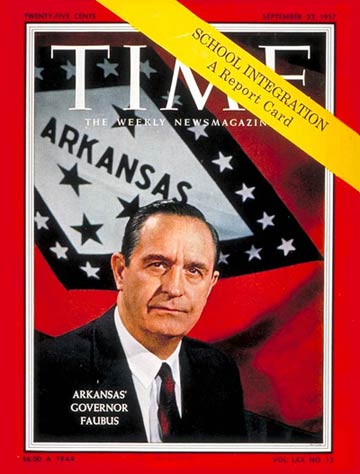
Arkansas Governor Orval Faubus
(7 of 7)
Hays started to move: first he called the White House, talked to his old congressional friend, Presidential Assistant Sherman Adams. He suggested that Governor Faubus and President Eisenhower meet. Hays himself set forth three conditions: 1) the request for a meeting would have to come from Faubus, 2) Faubus would have to be assured that his bid would not be rebuffed, and 3) there must be a real possibility that the meeting would result in something "constructive." Adams asked the President what he thought of Hays's plan. The answer was emphatic: yes, let him come.
Then Hays went to Faubus, spent a quiet hour talking in the book-lined second-floor study of the executive mansion. By this time Faubus was worn thin under the increasing pressures. He agreed to cooperate fully (but not to capitulate). Brooks Hays called Adams and said that a telegram was on its way from Faubus to the President at Newport, R.I.
The telegram was delivered to President Eisenhower just as he holed out on the 435-yd. first hole at the Newport Country Club. The President read it slowly. Press Secretary James Hagerty scratched an answer in pencil on the back of the telegram, handed it to the President. Ike changed a word or two, initialed the bottom: "DDE." The historic confrontation was arranged between the President of the U.S. and a governor of Arkansas who had wrought a lot more than he could handle.
Weeds in the Corn. Back in the Ozark hills Uncle Sam Faubus unknowingly told, in just a few words, why Orval had done all he had done. In the little house near Greasy Creek, he turned to his wife and exclaimed: "Why, Orval is the second-most thing in the papers these days." Replied she: "Firstmost thing." "Yep," agreed Uncle Sam. "Well, that's the way Orval always wanted it."
But now there were weeds in Orval's row of corn. They reached out of the field and out of the hills and around the world. They had created ugly patches on good ground, and before they stopped growing, they might well kill the very ambitions that Orval Faubus had cultivated with all his might.