

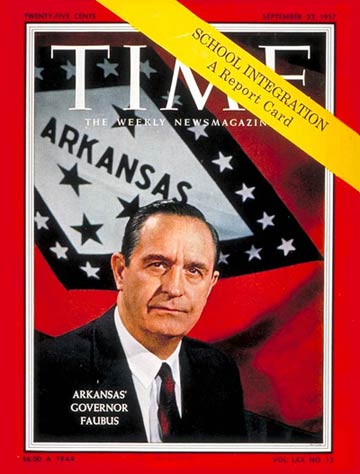
Arkansas Governor Orval Faubus
(4 of 7)
Hell for Sartain. All this—trouble in his own state, trouble in the South, trouble in the U.S. and trouble in the world—Orval Faubus had wrought. Why? The answers lie deep within a politician who fought his way out of a peckerwood background and a backwoods wilderness—and never wants to return.
Arkansas, part delta and part mountain, part magnolia and part moonshine, where a horse is a "critter" and a heifer is a "cow brute," is given to such place names as Loafer's Glory, Bug Tussle, Hell for Sartain, Hog Scald, Nellie's Apron—and, perhaps most remote of them all, Greasy Creek in the Ozark forests of the northwest, where Orval Faubus was born 47 years ago in a candlelighted cabin.
There the night fog wisps early along the creek valley, and the silence is broken only by the howl of timber wolves. There Orval Faubus, prematurely born and weighing only 4 Ibs., "growed like a weed" in the hardest of all soil. There Orval learned about politics from his father, "Uncle Sam" Faubus, a sort of mountain Populist. Last week in the Ozark woods, Uncle Sam, crippled from arthritis but still scratching a living from his hillside farm, mused on his son's fame. "Little Orval," said J. Sam Faubus, "he was different to most boys. Kids like to get into mischief, but all he ever did was read books. He never done anything if he couldn't do it perfectly. You'd never find a weed in his row of corn."
One Thing He Hated. Orval Faubus did not learn about segregation in the Ozarks. "He never saw a Negro until he was a grown lad," said Uncle Sam. "Then he went away North to follow the strawberry crop when he was about 18. We only had one Negro family in Madison County in those days, and they lived way down on the crick where nobody ever saw 'em. I told Orval not to hate anybody of any race. I told him people would think he was narrow-minded and would look down on him." Then Old Sam provided a key to the understanding of Orval Faubus: "That's one thing Orval always hated—to be looked down on."
Orval spent a lifetime clawing his way up so that he would not be looked down on. He found what he wanted in politics. For years he bounced from one meager job to another: country schoolteacher, itinerant farm hand, lumberjack. He ran for local offices (circuit clerk and recorder) and won, later wangled an appointment as postmaster. In 1948 he helped throw Madison County to liberal Sid McMath, who was elected governor. McMath named him to the nonsalary state highway commission, later responded to a Faubus plea ("I'm broke. I need a payin' job") by making him an administrative assistant at $5,000 a year. Orval Faubus moved to Little Rock—and (to him) the big time.