

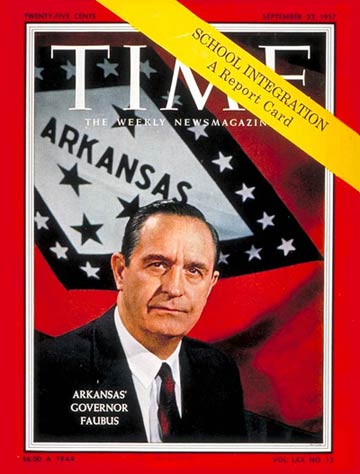
Arkansas Governor Orval Faubus
(6 of 7)
Neither then nor thereafter did Governor Faubus consult with the man charged by the Arkansas constitution with keeping law and order in Little Rock: Mayor Woodrow Wilson Mann."There was no indication of unrest whatever," says Mann. "We had no reason to believe there would be violence." For one thing, Little Rock had worked out for itself a seven-year integration plan, carefully picking and choosing among the Negro students most likely to do well, so as to minimize the possibility of trouble in a city with better-than-average race relationships. Even so, to be on the safe side, Mann and his 175-man police force had made carefully detailed plans to keep order. Orval Faubus never gave the mayor's plans a chance—and Woodrow Wilson Mann, who had twice supported Faubus for governor, is eloquent in his anger. Says he of Faubus: "His words spell sedition, his defiance rebellion. His words and actions echo another tragic period in our history when irresponsible men plunged this nation into a Civil War."
Order from the Court. Orval Faubus claimed to be unworried by Mayor Mann's criticism. He was holed up in his executive mansion, protected from intrusion by the National Guard, enjoying congratulatory telegrams, listening to piped music, watching Kinescopes of himself on television (he liked them), preparing to reap new publicity benefits.
Even as Orval was basking in his new fame, pressures against him were building up. Across town from the executive mansion, U.S. District Judge Davies was reading a 400-page report prepared for him by the FBI, which had 50 agents comb the Little Rock situation. The report showed not a shred of evidence supporting Faubus' claim that Little Rock had been ripe for violence. Example: where Faubus had said Little Rock stores were selling out of knives and pistols ("mostly to Negro youths"), the FBI agents checked 100 shops, found that weapon sales had actually been below normal. The report read, Judge Davies issued a summons commanding Faubus to appear in his court this week to show cause why an injunction should not be issued against him.
U.S. Marshal Beal Kidd, an old friend of Faubus, passed through the National Guard lines and handed Faubus the summons on the executive lawn. The summons genuinely worried Faubus: the man who hated to be looked down upon began to fret about the trouble his new prominence might bring him.
More Than He Could Handle. Faubus had other qualms. The political effect of his stand was not quite what he had expected. His old boss, Sid McMath, was busy rounding up liberals to denounce what Orval had wrought. Little Rock's respected Congressman Brooks Hays, top Baptist layman (president of the Southern Baptist Convention), checked with the city's leading citizens, found them shocked and ashamed.