

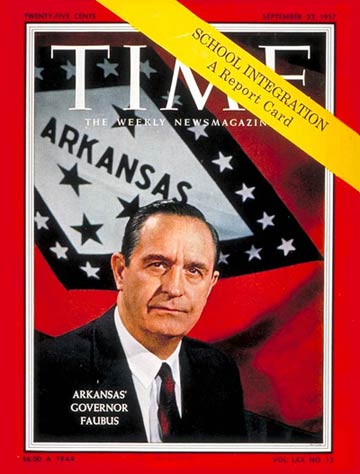
Arkansas Governor Orval Faubus
(2 of 7)
One hundred miles to the northwest, little Ozark (pop. 1,757), where racial conflict was unknown, had integrated its high school without a hint of protest. But the sparks from Little Rock soon landed and flared: a Negro girl was hit with a clothes hanger; a boy was struck in the back with a book—and a white motorist tried to run down two Negro children as they walked home from school. Integration was suspended, and Miss Elizabeth Burrow, half owner of the weekly Ozark Spectator, dying of throat cancer, wrote to her townspeople: "Here's a malignancy worse than my cancer, and I wouldn't swap with you."
Spreading Tension. What Orval Faubus wrought for Arkansas, he wrought for the South. Said the Knoxville, Tenn. News-Sentinel of Orval's stand: "This official act has lent an air of respectability and social approval to mob action." Violence exploded in Nashville (see below), and responsible officials attributed it directly to the impact of the news from Little Rock. In Charlotte, N.C., Dorothy Counts, Negro high school girl who had faced the jeers of a crowd with dignity and courage the week before, finally surrendered to heightened passion, withdrew from school.
In Louisville, a segregationist composed a battle hymn: "Stand firmly by your cannon/Let ball and grapeshot fly/And trust in God and Faubus/But keep your powder dry." In Alabama four potential candidates for governor set a political pattern for the South, each desperately trying to outdo the others in praise of Faubus. One wired Faubus his congratulations. Another promised to back Faubus "at all costs." A third offered to go to jail to prevent integration. The fourth topped them all: he was willing to die for segregation.
Fury in the North. The North, which has its own segregation faults, watched and smoldered with resentment. A Long Island summer-theater audience heard South Pacific Heroine Nellie Forbush say she was from Little Rock, stopped the performance with three minutes of furious boos and hisses. A drugstore clerk in Philadelphia admitted to human dilemma: "I don't like Negroes and God knows I'd hate to have to live with them—but I can't help thinking how awful it would be if my little girls had to go through a mob to be cursed and spit upon." Said a Negro bartender in Dynamite Jackson's Los Angeles saloon: "A lot of whites I know never got excited about this segregation thing in the past. Now they're red-hot under the collar."
Politically, Orval Faubus stabbed at the heart of his own Democratic Party. During the 85th Congress, Texans Lyndon Johnson and Sam Rayburn had labored tirelessly, skillfully and successfully to avoid a ruinous party blowup over civil rights. They had even contrived to put a Democratic stamp of sorts on civil rights legislation. Now Faubus had undone them—and Democratic politicians, in their acute embarrassment, could only pretend that Faubus did not exist. Lyndon Johnson became unavailable for comment. Grunted old Sam Rayburn, Speaker of the U.S. House of Representatives longer than any other man in history: "I'm not making any comment about segregation at all, my friend, one way or another. It's not my problem."