

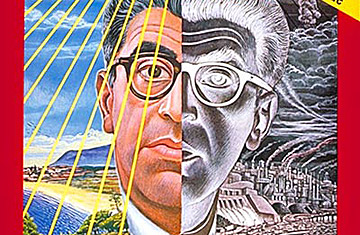
The great question of the '70s is:
Shall we surrender to our surroundings or shall we make our peace with nature and begin to make reparations for the damage we have done to our air, to our land and to our water?
—State of the Union Message
NIXON'S words come none too early. The U.S. environment is seriously threatened by the prodigal garbage of the world's richest economy. In the President's own boyhood town of Whittier, a part of metropolitan Los Angeles, the once sweet air is befouled with carbon monoxide, hydrocarbons, lead compounds, sulfur dioxide, nitrogen oxides, fly ash, asbestos particulates and countless other noxious substances. The Apollo 10 astronauts could see Los Angeles as a cancerous smudge from 25,000 miles in outer space. Airline pilots say that whisky-brown miasmas, visible from 70 miles, shroud almost every U.S. city, including remote towns like Missoula in Montana's "big sky" country. What most Americans now breathe is closer to ambient filth than to air.
The environment may well be the gut issue that can unify a polarized nation in the 1970s. It may also divide people who are appalled by the mess from those who have adapted to it. No one knows how many Americans have lost all feeling for nature and the quality of life. Even so, the issue now attracts young and old, farmers, city dwellers and suburban housewives, scientists, industrialists and blue-collar workers. They know pollution well. It is as close as the water tap, the car-clogged streets and junk-filled landscape—their country's visible decay, America the Ugly.
Politicians have got the message. Late last year, Congress easily passed Senator Henry M. Jackson's National Environmental Policy Act and appropriated $800 million to finance new municipal waste-treatment plants. Senator Gaylord Nelson plans to introduce an amendment to the U.S. Constitution that will guarantee every citizen's right to a "decent environment." Last month, the Governors of New York and California devoted much of their "state of the state" speeches to environmental matters; campaigns later this year will reverberate with antipollution statements. Says Senator Edmund S. Muskie: "In the past, we had to fight against all kinds of political pressure, public apathy and ignorance. Now the wind is blowing at our back."
The New Jeremiahs
The real problem is much bigger than the U.S. By curbing disease and death, modern medicine has started a surge of human overpopulation that threatens to overwhelm the earth's resources. At the same time, technological man is bewitched by the dangerous illusion that he can build bigger and bigger industrial societies with scant regard for the iron laws of nature. French Social Anthropologist Claude Levi-Strauss compares today's human condition to that of maggots in a sack of flour: "When the population of these worms increases, even before they meet, before they become conscious of one another, they secrete certain toxins that kill at a distance—that is, they poison the flour they are in, and they die."
Ultimately, both men and maggots need the help of an emerging science of survival—ecology. In the U.S., a tiny band of ecologists has achieved sudden prominence: Rene J. Dubos (Rockefeller University), LaMont C. Cole (Cornell), Eugene P. Odum