

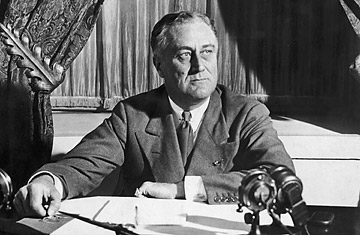
President Franklin Roosevelt
(4 of 4)
¶Congress stirred to a bigger issue: Kentucky's leathery Representative Andrew May, chairman, House Military Affairs Committee, called for repeal of the hitherto inviolable Johnson Act, banning all U. S. loans and credits to any defaulting debtor nation which blocks loans to the Allies. The Act's author, old World War I Isolationist Hiram Johnson of California, cried indignantly ". . . road to war." > What stand, if any, should the G. O. P.
take on foreign affairs? 15J"on-conformist Republican Wendell L. Willkie slugged that question at his own party's keynoter, Isolationist Governor Harold Stassen of Minnesota. Speaking in Minneapolis, heart of supposedly Isolation country, Mr.
Willkie snapped: "I say to him, in all seriousness, that if he, as keynoter of the Republican Party, attempts to put the Republican Party on record as saying what is going on in Europe is none of our busi ness, then we might as well fold up." Minnesota's Republicans forthwith presented Mr. Willkie with his first delegates. ^ Wrote Editor Felix Morley in the Washington Post: "Neutrality has no meaning when such a merciless military machine is in full operation. . . . No country can possibly be indifferent ... all those not actually at war, or poised to strike at the strategic moment, are preparing to fight for their independence.
"Nor can it be said realistically that the U. S. is any longer neutral."
As if to echo these sentiments, in Buenos Aires Argentine Foreign Minister Jose Maria Cantilo, after conferring with U. S. Ambassador Norman Armour, proposed that the Americas make a new declaration of solidarity, stronger than any heretofore. Neutrality, said Minister Cantilo, is a "fiction," a "dead conception." The Americas should adopt an attitude of "nonbelligerency," like Italy's: wholly sympathetic with one belligerent.
Toward this position, un-neutral but not yet belligerent, it appeared that the U. S. was moving, if not in theory, in fact.