

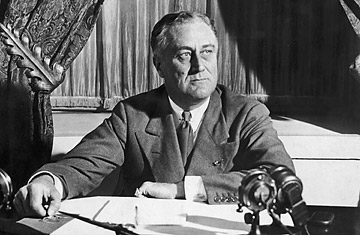
President Franklin Roosevelt
(3 of 4)
Such were the odds & ends, the tags of U. S. reaction to affairs abroad. But something deeper, broader, more important was happening. The fiddlestrung nerve-tension of the cable-readers and policy-makers spread from Washington across the land, jumped out of loudspeakers and off blocks of black Gothic-type headlines. Still clinging to its original determinations to stay out of World War II, the U. S. was acquiring another—to prevent by other means a Nazi victory. To get additional evidence of the trend of feeling TIME asked many of its correspondents to report on local sentiment. Most striking fact: local variations normally expected from such an impressionistic poll were practically nonexistent. Typical reports: ¶ Columnist Ralph McGill wrote a piece in the Atlanta Constitution on British slowness; his phone rang all one morning with agreements from Constitution readers. Observers found steadily firming sentiment for U. S. intervention; a banker told his directors "Now is the time to intervene." Distinct and widespread was sentiment for immediate increase in national defense measures.
^ In Massachusetts, crowds stood on Boston's Washington Street watching news bulletins posted, grudgingly admiring Nazi efficiency, grim at the prospect of Nazi victory. Said many: "We'll be in it if it keeps up six months." ¶ The Portland Oregonian's Pulitzer Prize associate editor, Ronald G. Callvert, said Franklin Roosevelt's speech (see p.
16) "expressed the feelings of the American people." ¶ Many Californians talked of U. S. naval participation in the war; and a feeling of inevitability was widespread. ¶Isolation is impossible, U. S. entry inevitable, said Louisianians fatalistically, as they concentrated on the more immediate business of eating 1,000 steers in a barbecue celebrating the end of the late Dictator Huey Long's machine.
¶ In Chicago, "I hope they send you first," was a common gag.
¶ A frequent remark in Omaha: "It looks like we can't keep out." For weeks flights of bombers, throbbing overhead in the dawn, en route from California to the Allies, have awakened Nebraskans, who went back to sleep uneasily. Two State Republican leaders said privately they could now calmly contemplate Term III for Franklin Roosevelt.
This nationwide surge of indignant public opinion was the U. S. news of the week.
¶In Washington, lean-jibbed Harry Hopkins, Secretary of Commerce, brought together business advisers, economists, trade experts, canvassed the problem: how to acquire and conserve stocks of strategic materials if the Indies' supply sources are impaired. Rolling up on all sides was a flood of criticism of a Congress which has consistently refused to take Franklin Roosevelt's tip and appropriate many millions of dollars to purchase stocks of strategic materials.
¶ At the Treasury bald, solemn Secretary Henry Morgenthau Jr. went down at dawn to throw the switches freezing Dutch, Belgian and Luxembourg bank balances so that Nazi plunder may not include approximately $1,076,000,000 Dutch, $296,000,000 Belgian, and $14,-000,000 Luxembourger investments in the U. S.