

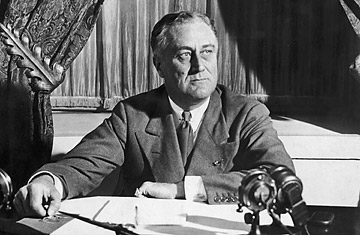
President Franklin Roosevelt
Twenty years ago the U. S. deliberately turned its back on a world made safe for Democracy, elected Ohio's Warren Gamaliel Harding President, sang How Ya Gonna Keep 'Em Down On the Farm and swore by the Founding Fathers: never again.
That oath, sworn in a memorv of sac rifice and bloodshed, gradually soured into a disgusted resolve. The Allies didn't pay their war debts, Uncle Sam became Uncle Shylock, the country heard that the holy crusade had been waged to make good J. P. Morgan's loans, that Our Buddies were the pawns of the munitions-makers, that the Road to War was paved with baloney; the blood had been shed not by heroes, but by suckers.
Everybody was an Isolationist, regardless of party. The first New Dealers who went to Washington with Franklin Roosevelt were the New Isolationists, intent on a Brave New World. Raymond Moley, impatient with the fuddy-duddy, international-cooperation ideas of Tennessee's Cordell Hull, was horrified at the President's willingness to consult with Herbert Hoover's world-minded Secretary of State Henry L. Stimson. "Three thousand miles of good green water" on each coast seemed an ample guaranty of security forever.
A few patient voices droned on about the moribund League of Nations, international trade, U. S. responsibility. As the tempo quickened, and bombers roared over Ethiopia, Spain, China, the U. S.
stirred like a man trying not to wake from a pleasant dream. Isolationism grew more vocal than ever; Congress passed, tightened up, a Neutrality Act which abandoned the freedom of the seas.
Franklin Roosevelt, reading the cables day after day, saw something coming.
Austria went down, then Czecho-Slovakia.
As Munichtime dragged away, voices joined the old chorus, saying this is a small world. The wheels rolled faster, Berlin and Moscow joined hands, Poland vanished in a clap of thunder. World War II crystallized Isolation as the dominant U. S. mood.
Finland's turn came; then Denmark, Norway. Isolationists might dispute the trend, but signs multiplied that public sentiment had grown by leaps & bounds in favor of the President's policy (still unannounced) of giving the Allies every aid short of war.
Last week, as Hitler struck into The Netherlands and Belgium, Isolationists fell almost mute. And in the momentary silence U. S. public opinion began to find tongue.
¶ In New York City's Times Square 15 patrolmen, three mounted police herded cars through a great crowd that spilled into the streets, attentive, grim, unusually silent, under the bulletins racing across the Times Annex.
¶ The press showed anger and alarm.
Once-isolationist newspapers demanded preparedness on a scale unthinkable two months ago. The Chicago Tribune denounced Army & Navy bureaucrats, called the Navy obsolete, insisted on a mammoth air force.
Wrote the New York Times: "Aggression run mad . . . Germany's insanity . . . brutal . . . murder in cold blood. . . .