

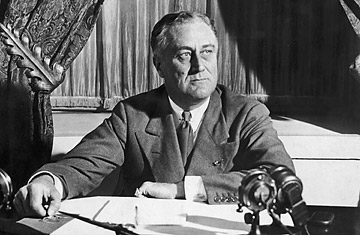
President Franklin Roosevelt
(2 of 4)
[Hitler] has staked everything on a gigantic gamble which, if he wins, will mean the end of freedom and democracy and culture throughout all Europe in our time. ..." Colonel Frank Knox wrote some 1,500 scorching words in the Chicago Daily News, exhorting preparedness, demanding the U. S. "help in every way short of war itself, those who are now fighting the bestial monster that is making a shambles of Europe." ¶Words of the late General Billy Mitchell, U. S. Air Chief in World War I, who was demoted, court-martialed by the U. S.
Army in 1925 for accusing the high command of incompetence, were dug up by Scripps-Howard Reporter Ruth Finney: "In future wars it will be too late to organize an air force after the contest begins." ¶ In Congress, rabid Isolationist Hamilton Fish stunned the House by voicing a solemn hope for non-partisan harmony in the crisis, a hope that "at least for the time being no effort will be made to criticize the Administration. . . ." ¶The American Red Cross ordered 50 more air-conditioned ambulances, 100 auxiliary hospital trucks, ten field hospitals, quantities of surgical instruments; drove for another $10.000,000.
¶Chicago Osteopath Dr. Walter Donald Craske told an Illinois Osteopaths Convention that the war, and fears of U. S. involvement, were giving millions of cit;zens high blood pressure.
¶ In Manhattan's Ritz-Carlton, 15 sumptuous gowns specially designed by ranking French couturiers, and worn by debutantes and young matrons, were auctioned for the benefit of the French. Top price: $700.
For $375 a fashion designer bought a short-length Bruyere creation in black net with taffeta inserts (modeled by Barbara Gushing, sister of the President's ex-daughter-in-law, Mrs. James Roosevelt).
As the stockmarket plummeted, U. S. business took sharp stock of the fact that spreading war had wiped out at least half of a $161,125,000 yearly market (see p.
78), of the fact that if the U. S. should find itself at war with Japan in the Far East it will be cut off from the Indies, and other Eastern areas, which produce 90% of the world's rubber, 50% of the world's tin, tungsten (21%), manganese (27%), quinine (95%), Manila fibre (100%).