

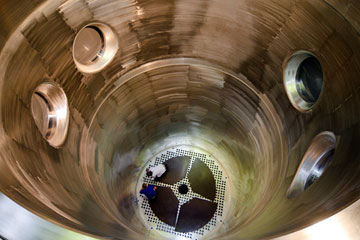
Employees of Skoda Jaderne Strojirenstvi AS. inspect the base of a core barrel manufactured for use in the Olkiluoto nuclear power plant in Finland, at the Skoda JS factory in Pilsen, Czech Republic, on Friday, Aug. 27, 2010.
(4 of 4)
The challenge of nuclear waste--another factor that has held back new construction in the U.S., since no one can agree where to put it--is also at the heart of another atomic start-up. TerraPower is experimenting with a traveling-wave reactor design, which would largely eliminate the need for uranium enrichment. (Traveling wave refers to the fact that fission occurs bit by bit in the reactor core, as if a wave of energy were slowly spreading through it, rather than in the entire core all at once as in standard fission.) In conventional reactors, composition of the isotope uranium-235 has to be increased in the fuel before it becomes fissile. TerraPower's reactor design could use the depleted uranium found in nuclear waste, burning it for decades without refueling. If it works, the traveling-wave reactor--one of a number of designs TerraPower is researching--would be far more efficient than current designs, holding out the possibility of near limitless electricity. That revolutionary potential is what attracted Bill Gates, who is one of TerraPower's main funders. "We think we could have a prototype by the early 2020s and become the commercial reactor of choice by the 2030s," says John Gilleland, TerraPower's CEO.
That's the dream. The reality is that bringing any of these next-generation reactors to market would take billions of dollars and a lot of luck. It's hard to imagine a private company shelling out that kind of capital up front on an idea that might never pay off--and it's equally difficult to picture governments stepping up in an age of austerity. Nuclear critics fear that any design that would significantly reduce costs would inevitably skimp on safety. "As a general rule, the more excess safety margins you build in, the more expensive it's going to be," says Edwin Lyman, senior scientist at the Union of Concerned Scientists' global-security program. "It's a hump you can't get over."
That won't deter Dewan or the rest of the young engineers working a nuclear renaissance, for whom climate change has changed the rules. "Everyone's coming at this from an environmental perspective," she says. "There's a sense of possibility that we can invent new things in the realm of nuclear to save the world." If a melting Arctic really is scarier than a meltdown, advanced nuclear might just have a chance.
FOR MORE IDEAS FOR THE FUTURE, VISIT time.com/breakthrough