

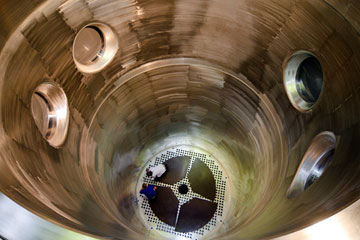
Employees of Skoda Jaderne Strojirenstvi AS. inspect the base of a core barrel manufactured for use in the Olkiluoto nuclear power plant in Finland, at the Skoda JS factory in Pilsen, Czech Republic, on Friday, Aug. 27, 2010.
(3 of 4)
The AP1000--and other new designs, like Areva's EPR, currently being built in France, Finland and China--is evolutionary, not revolutionary. It still uses enriched uranium as fuel and ordinary water as the coolant, which means it doesn't address concerns about nuclear waste or proliferation. But there are companies looking to take a bigger leap. One idea that's grown popular is the small modular reactor (SMR). Designed to be about a third the size of traditional reactors, SMRs can shrink the multibillion-dollar up-front costs of a conventional nuclear plant. Less nuclear fuel means that even if something goes wrong, you won't see the widespread radioactive contamination that can happen after a meltdown at a normal-size plant. Because they're small and standardized, SMRs could be mass-produced and then shipped wherever they're needed, which could mean an end to construction delays that can stretch to years. A number of small start-ups, like Hyperion and NuScale, have put forward SMR designs, and the Department of Energy agreed in June to provide $150 million to support the development of a Babcock & Wilcox subsidiary's SMR design. Overcomplexity has always been the bane of nuclear technology--both in cost and safety. SMRs promise simplicity. "When you're small, it just becomes a lot easier to manage everything," says UPower's DeWitte.
To really change the economics of nuclear, however, you need to fundamentally change how plants operate. That's where Generation IV reactors come in. These designs--none of which has yet gotten to the prototype stage--alter the kinds of fuel and coolant that would be used, experimenting with mixes that potentially offer inherent safety, greater efficiency and less waste. Dewan's company, Transatomic, is developing a molten-salt reactor. Instead of the familiar nuclear rods, it uses fuel dissolved in a salt mixture. At the bottom of the reactor vessel is a drainpipe plugged with solid salt, its temperature maintained with an electrical cooler. Should power be lost in a Fukushima-like accident, the plug would melt and the molten salt containing the fuel would drain into a storage area, where it would cool on its own. "You just coast to a stop," says Dewan. The reactor would also be able to use the atomic fuel found in nuclear waste, which means more efficiency and less radioactive by-product.