

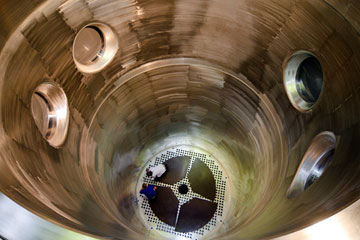
Employees of Skoda Jaderne Strojirenstvi AS. inspect the base of a core barrel manufactured for use in the Olkiluoto nuclear power plant in Finland, at the Skoda JS factory in Pilsen, Czech Republic, on Friday, Aug. 27, 2010.
(2 of 4)
But it's not just irrational fear that brought the nuclear industry to a virtual halt in the U.S. and much of the rest of the world. The costs of building new plants ballooned, with construction often coming in billions of dollars over budget. Outside of France, atomic plants weren't standardized, which meant that nearly every reactor was produced bespoke--like a suit bought from a tailor instead of off the rack. The current generation of plants was derived from old Cold War technology, and as the Fukushima meltdown showed, those reactors are vulnerable to a sustained loss of power that shuts off the flow of cooling water to the nuclear fuel. Even though the health impact from the Fukushima fallout is likely to be minimal, the economic cost could exceed $100 billion. That's a number that will be in the mind of any regulator considering a new nuclear plant--especially with competing natural gas so plentiful thanks to fracking.
So if nuclear is going to achieve what young engineers like Dewan and DeWitte are hoping for, the industry is going to need a new generation of reactors that are cheaper and safer. In the U.S., that will start with Southern Co.'s new Vogtle nuclear plants, which began construction in 2009 in northeastern Georgia. Southern is using a new reactor design: Westinghouse's AP1000, the first Generation III+ reactor to be built in the U.S. (Generation I reactors were early prototypes; Generation II includes nearly all of the commercial reactors currently operating.) The AP1000 has passive safety features--in the event of an accident, the plant is designed to automatically shut down, with no need for human intervention or outside power for up to 72 hours. As a result, the AP1000 requires significantly fewer components, reducing the redundancies that have driven up construction costs in the past. And large sections of the plant are being built off-site in prefabricated sections before being shipped to the plant and welded into place. "The passive safety design allows you to get water to where it needs to be without an external power source," says Tom Fanning, Southern Co.'s CEO. "That would have obviated a lot of the problems at Fukushima."