

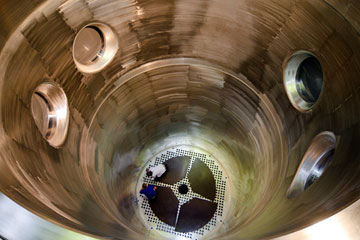
Employees of Skoda Jaderne Strojirenstvi AS. inspect the base of a core barrel manufactured for use in the Olkiluoto nuclear power plant in Finland, at the Skoda JS factory in Pilsen, Czech Republic, on Friday, Aug. 27, 2010.
Leslie Dewan was 1 year old in 1986 when the Chernobyl nuclear plant in Ukraine melted down. Dozens of people died in the immediate aftermath of the catastrophe, and clouds of radiation spread over parts of Europe, contributing to thousands of excess cancer deaths. But the fallout experienced by the nuclear-power industry was almost as dire. Although the meltdown at Chernobyl had more to do with the failures of Soviet engineering than with nuclear power itself, the industry was dealt a crippling blow by the worst accident in its history. In the U.S., where memories of the partial meltdown at Three Mile Island in 1979 were still fresh, nuclear construction hit a standstill: no new plants were started for more than 30 years. For a smart young engineer like Dewan, who entered the Massachusetts Institute of Technology (MIT) as an undergraduate in 2002, the nuclear industry might seem like a dead end.
But that's not how Dewan sees it. For the 28-year-old--and for a growing number of other young scientists interested in energy--Chernobyl is at most a dim memory. They see nuclear power as far from an existential threat to the planet but instead as the best way to save it, and they're trying to revive the stalled industry with next-generation reactor designs that could change the way a skeptical public views atomic energy. Dewan just completed her doctorate in nuclear engineering at MIT, and in her spare time she co-founded a start-up called Transatomic Power, which has plans to build a safer and cheaper nuclear reactor, one that couldn't melt down like the older plants at Chernobyl or Fukushima. "I've always been concerned about global warming," she says. "It seemed to me like working in nuclear power was a logical way to do something to help the environment."
We tend to pay attention to nuclear power only when something goes wrong, but for all its high-profile problems, nuclear has proven less deadly than almost every other form of electricity on a megawatt-by-megawatt basis. (Air pollution from coal, the top source of electricity in the U.S., contributes to the deaths of 14,000 people a year.) And aside from hydroelectric--which has mostly hit its growth limits and has its own side effects--nuclear is the only large-scale, always-on source of power that doesn't contribute to global warming. If you know about energy and care about climate change--like Dewan--there's no reason why you wouldn't be attracted to nuclear. "I was always fascinated that something could produce so much energy with so little fuel," says Jacob DeWitte, another MIT grad student and the founder of the micro-nuclear start-up UPower.