

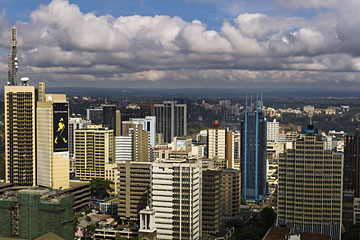
Nairobi is a vibrant high-tech hub — and a place of violent unrest
(4 of 4)
In East Africa, since 2010, al-Qaeda-allied al-Shabab has extended its reach beyond its base in Somalia, carrying out attacks across Kenya and Uganda that have killed 150 people. It is supported on the Muslim-dominated Kenyan and Tanzanian coasts by groups of Islamist separatists.
The Kenyan state's exclusion of Muslims is nowhere more visible than in Eastleigh, a Nairobi suburb of some 500,000 residents who are mainly ethnic Somalis. In Eastleigh, roads, sewage, rubbish collection and state provision of health care and education are on a par with services provided in the war-ravaged Somali capital, Mogadishu. On Nov. 18, suspected al-Shabab militants detonated a bomb inside a matatu in Eastleigh, killing seven people and injuring 30. Reprisals were swift: within minutes ethnic Kenyans were stoning ethnic Somalis in the streets. Rioters began looting stores, and the police had to separate groups of angry youths. Several weeks before the violence, unemployed international-relations graduate Mohamud Hussein Adan, 22, sits sipping a soda in an Eastleigh café, describing what might drive some in his community to become radicalized. "The police harass us and make us feel like second-class citizens," he says. "And when people feel excluded, some feel they have no option but to break the law. They start associating with extremists. They become capable of anything."
A Continent of Entrepreneurs
Amid such instability, it can be hard to imagine progress. Perhaps that's why Africa's successes can sound almost like fantasy. Take Ecobank, a global retail bank with assets of $18.5 billion, deposits of $13.1 billion and 1,197 branches and 23,500 employees in 32 countries — all managed from the small nation of Togo. Or the Ethiopian Commodity Exchange: a generation after a famine killed a million people, Ethiopia's first yuppies are food traders at Africa's first agricultural-commodities exchange.
Non-Africans can find it hard to grasp the coexistence of such great promise with such great problems. The $130 billion-a-year aid industry retains a singular focus on crisis. Western bankers, meanwhile, seem to see only Africa's prospects. But sub-Saharan Africa, with its 48 countries and 3,000 languages, is inevitably a place of adversity and opportunity. Geldof suggests the former might even lead to the latter. Where does Africa get its spirit of enterprise? he asks. "If you're constantly scratching for a living, you're an entrepreneur."
The world's emerging economic powerhouses, with their own experience of the shades and tones of transition, find it easier to digest Africa's simultaneous potential and pitfalls. China has taken the lead. Two-way trade with Africa — often in infrastructure-for-resource swaps that have given the continent an infrastructure makeover that runs from roads, ports and railways to airports, hospitals and dams — hit $166 billion in 2011. (The U.S., long Africa's biggest trading partner, recorded $126 billion.) Also in pursuit of Africa's oil and gas, coal, timber, minerals and farmland are India, Brazil, Malaysia, Turkey and the Gulf states. "There is a new Great Game being played out in Africa," says Geldof. "Yet much of the West ignores this geostrategic giant."
That will inevitably change. Mozambique's offshore Rovuma-1 block has bigger natural gas reserves than all of Libya, while initial estimates are that Somalia has as much oil as Kuwait. The continent has 60% of the world's unused arable land. As Geldof says, "In the end, we all have to go to Africa. They have what we need." And if the first scramble for Africa — as historians dubbed the period from the 1870s to 1900 — was a European imperialist carve-up, it is in this second scramble for Africa that the continent's best hopes lie. The more needed Africa is, the less needy — and the more powerful — it can be. It is, says Tutu, a moment of extraordinary possibility. With the right governments, "we have the capacity to do wonderfully well," he says.
So tantalizing is the new hope across Africa, it infects even the most skeptical. Asked to imagine the future, Mwangi predicts one day returning to photography to capture a very different Kenya. Whatever unrest may come, ultimately it will be an interlude on the path to progress, he says. "There are tough days ahead. There will be violence. But eventually you'll see an evolution. We'll be a new country, stable and with a government with standards. We'll be reborn. Out of the old will come the new." With a bit of luck, that's a story he'll be shooting across all of Africa.