

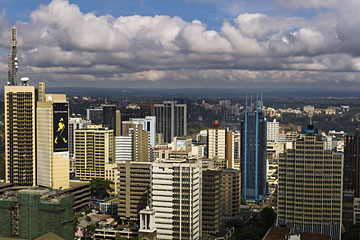
Nairobi is a vibrant high-tech hub — and a place of violent unrest
(3 of 4)
The wasted lives of Murang'a's young men reflect a pattern: across Africa, governments are failing to convert growth into jobs. According to an August report by analysts McKinsey & Co., 275 million out of a total African workforce of 382 million are either unemployed or in informal day-hire work. By 2020 a youth surge propelled by the world's highest birthrates, which will raise Africa's population from 1 billion in 2009 to 2 billion in 2050, will add a further 122 million Africans of working age. That would be a boon if they had work. But McKinsey calculates that in the same period, Africa will create just 54 million to 72 million more jobs. "If current trends continue, it's going to take Africa until 2066 before employment levels reach those of East Asia," says David Fine, one of the report's authors. "It's a risk. People need opportunities."
Asia does give some clues as to what's coming next, however. The past three decades in the East may set a stunning example of economic progress, but they are also a warning about the incendiary effects of inequality. The divide that has opened up between rich and poor in China helps fuel hundreds of antigovernment protests a day. This year the Indian state has faced a tide of anticorruption demonstrations. The lesson from these stars of globalization is that massive social improvement is inevitably massively socially disruptive. When corruption blocks growth's gains from being fairly shared, discontent can become explosive. In India, for example, a 20,000-strong Maoist rebel army, the Naxalites, regularly attacks police and army outposts across a wide swath of territory in the center of the country. The group's ultimate aim: the defeat of global capitalism.
In Africa, with its history of detached elites, corruption and using violence to achieve goals, the path to prosperity will likely be bumpier. Add the looming prospect of 300 million jobless young, and the imperative for any African government looking to mitigate the turbulence is clear. "The next part [of Africa's development] is jobs," says Geldof. "What will it take to fill that void?"
McKinsey argues that the answer lies less in Africa's traditional extractive industries — which tend to be capital-intensive — and more in sectors such as tourism and retail, which employ more labor. But what happens if, as McKinsey predicts, the void cannot be filled? South Africa provides an example of a government's paying the price for failing to share the gains of growth. Since the end of apartheid in 1994, South Africa, the continent's biggest economy, has expanded by up to 5% a year. But 18 years in power has changed the African National Congress (ANC) from the party of Nelson Mandela's righteous revolution into just another rapacious developing-world elite. Unemployment runs anywhere from 25% to 40%, state-run education can be among the worst in the world, and inequality — stretched wider by a fabulously wealthy ANC-connected cabal — has increased.
The ANC is reaping the reward for this sorry record. In mid-August, 3,000 miners at platinum producer Lonmin's Marikana mine in northern South Africa walked off the job, demanding a tripling of basic pay, from about $500 per month. On Aug. 16, after days of violence in which 10 people died, police shot dead 34 miners. The killings evoked the brutality of apartheid. Meanwhile, the militant antibusiness, antigovernment strikes that erupted at other mines, then in other industries, continue today. While the ANC's ruling alliance suggests that the party represents the poor, these protests have exposed such claims as nothing more than a hollow fraud. With such a disconnect between government and people, Tutu says, the potential for upheaval in South Africa is "very great ... When the big eruption happens," he says, "it's going to be very, very disturbing."
Just as worrying is another type of unrest emerging in East and West Africa. Marginalization divides rich from poor, but it also aggravates existing tribal, racial and religious fault lines, and a series of Islamist insurgencies is now erupting below the Sahara. From the Atlantic to the Indian Ocean, young Muslims are taking up arms against governments they see as Westernized, corrupt and shutting them out of economic opportunity. In dirt-poor northern Nigeria, the Islamist Boko Haram is running a bloody insurgency against the state and its southern Christian President in which thousands have died. In Mali, jihadists have seized the northern half of the country and imposed Shari'a, creating what is, in effect, a militant Islamist state just south of Europe.