

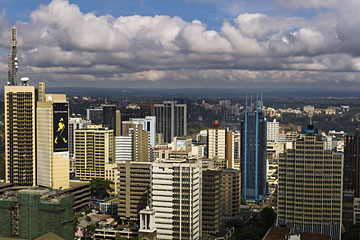
Nairobi is a vibrant high-tech hub — and a place of violent unrest
Boniface Mwangi's first camera was an old Japanese film model, bought with $220 borrowed from a friend. He'd been selling books at his mother's roadside stall in Nairobi since he was 15. Then one day in 2003 he came across a biography of Kenyan photographer Mohamed Amin, whose pictures of the 1984 Ethiopian famine, the book implied, led to Band Aid, Live Aid and a new era of global humanitarianism. "That book opened a new world for me," says Mwangi. "Here was another high school dropout who went on to conquer the world using his camera." Mwangi set out to do the same. Within months his photographs were being published in Kenya, and in a year he had won a national award for Best New Photographer. His inches-close pictures of the tribal bloodletting that followed a disputed 2007 general-election result in Kenya earned him a slew of awards, a letter from U.S. Secretary of State Hillary Clinton praising his "incredible talent" and a grant from the New York City — based Magnum Foundation.
For many, the story of the street hawker who became a world-class photographer seemed to epitomize the notion of an emerging Africa: a giant continent awakening from poverty and disaster, now bursting with hope and opportunity.
Then Mwangi quit. He was haunted by the idea that his success was built on his country's turmoil. He wouldn't, couldn't go on photographing the politicians he heard promise Kenyans a new dawn, only to rob them, ignore them and then, come an election, allow violence to break out. Whatever the cost to his career, the price his country was paying for that kind of execrable leadership — which led to more than 1,000 murders during the 2007 — 08 election crisis, along with the theft of billions of dollars from the state — was far greater. "We didn't vote for these guys for them to screw us," he says.
So in 2011, Mwangi formed a group of street artists, with whom he began staging guerrilla art attacks across Nairobi. Aerosol stencils of vultures began to appear on sidewalks and road crossings. Then more-elaborate murals appeared — of vultures urinating and wiping their backsides on the Kenyan flag. One February night, Mwangi's group painted a 12‑m tableau on a downtown wall, depicting a smirking, suited vulture sitting next to a list of what the artists saw as Kenyan politicians' crimes since independence. "MPs — screwing Kenyans since 1963," read the caption. "Africa is rising," says Mwangi, now 29. "But there's also a lot of anger. There's trouble ahead."
As Africa marks half a century since it began to free itself from colonialism, its future lies in the hands of hundreds of millions of young Africans who, like Mwangi, must choose between Africa rising and Africa uprising. It is not, as the cynics have it, that Africa will never move beyond dictators and disasters, that it cannot and will not develop. Africa's progress is real, dramatic and, by now, well established. The International Monetary Fund says that since 2003, GDP across sub-Saharan Africa's 48 countries has risen an average of 5% to 7% per year. In the past decade, six of the 10 fastest-growing countries in the world were African, and this year five African countries will outgrow China, 21 will beat India and only two — Gambia and Swaziland — will expand more slowly than Europe and the U.S. The result of all this growth? Africa is in the midst of a historic transition, and during the next few decades hundreds of millions of Africans will likely be lifted out of poverty, just as hundreds of millions of Asians were in the past few decades. Bob Geldof's evolution from Live Aid organizer to, this February, the founder of a $200 million Africa-focused private-equity fund is emblematic of the transformation. "This could be the African century," he says.
Old Habits
But if Afro-pessimism is outdated, undiluted Afro-optimism is premature. Africa's progress, though real, will not be smooth. Historically the continent labored under predatory inequality and clownish tyranny. President Mobutu Sese Seko of Zaïre (now the Democratic Republic of Congo) would charter a Concorde airplane for European shopping trips while his people starved. Malawi's Hastings Banda had tent pins hammered into opponents' heads and required his portrait to hang higher than any picture or clock in the country's public buildings. Today, while Africa's economies are modernizing, its rulers too often are still not: in many countries, corruption and impunity — and the inequality that results — are still routine. "With a very few notable exceptions, our leaders are not part of accountable governments," says Archbishop Emeritus Desmond Tutu, chairman of the international mediation body and rights watchdog the Elders. "It's still, If they perform abominably, so what?" The continent's leaders are, by one important measure, less accountable than they were in the past. Since it was set up in 2007 by a Sudanese telecom billionaire, the Mo Ibrahim Index of African Governance has recorded a striking divergence: material improvement along with political deterioration. This year, for the third time, Mo Ibrahim's foundation declined to award its $5 million prize for African leaders who leave office peacefully and democratically. "We are not completely out of the past and into the future," says Ibrahim.