

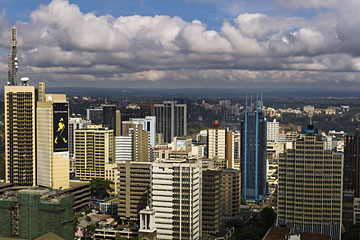
Nairobi is a vibrant high-tech hub — and a place of violent unrest
(2 of 4)
More than anyone else, it will be young Africans who shape that future. The Arab Spring showed what can happen when sclerotic, corrupt regimes that oversee strong overall growth fail to share the gains or greater political freedom with a connected and well-educated youth. All those ingredients exist in potentially even more explosive proportions in Africa. The average African is 19, while the average Middle Easterner is in his or her 20s. Thanks to foreign aid, hundreds of millions of Africans are better educated than ever — and they expect more-rewarding jobs. And by 2016, there will be over a billion cell phones in use on the continent, according to industry analyst Informa Telecoms & Media, giving nearly every African access to that most essential tool of 21st century rebellion. It is a recipe for, simultaneously, entrepreneurialism and revolution. John Githongo, a former Kenyan anticorruption czar forced out by death threats who is now a civil-society activist, says, "There's truth to the optimism about Africa. But if you do not share the benefits, there is a price to be paid. And it's paid in blood."
Boomtown
As Kenya's capital and East Africa's business hub, Nairobi encapsulates Africa's transformation. Steel-and-glass skyscrapers dominate colonial bungalows, and BMWs and SUVs fill what were once empty highways. Nairobi is where Stelios Haji-Ioannou, the founder of British budget airline easyJet, is launching a low-cost African airline and where pay-as-you-go solar panels are making power grids obsolete. From vendors at traffic lights selling iPad chargers to millions of neatly suited commuters and a sudden ubiquity of sushi, signs of change are everywhere. Average incomes have close to doubled in a decade, and if the economy continues to expand 5% annually as expected, a nation of mud huts will become a middle-income country by 2016.
Africa owes its takeoff to a variety of accelerators, nearly all of them external and occurring in the past 10 years: billions of dollars in aid, especially to fight HIV/AIDS and malaria; tens of billions of dollars in foreign-debt cancellations; a concurrent interest in Africa's natural resources, led by China; and the rapid spread of mobile phones, from a few million in 2000 to 750 million today. Business increasingly dominates foreign interest in Africa. Investment first outpaced aid in 2006 and now doubles it. And inside the aid world, a rising number of initiatives are run by businesses or businessmen like Bill Gates, the co-founder and chairman of Microsoft, and focus less on simple assistance, like sending food, and more on economic development, like programs to raise farm production.
While these phenomena combine in a tsunami of change at a continental level, their local impact can be uneven, and Nairobi is a prime example. Pass through the city center at noon and you'll find daily protests by striking doctors, teachers and university lecturers, all demanding increases in what are, in some cases, risible wages. Return at night and downtown is deserted save for a small army of private security guards protecting steel-shuttered businesses against thieves who journey in from outlying squatter camps. A short minibus, or matatu, ride takes you to the giant clapboard slum of Kibera, home to 250,000, where most evidence of either development or the state — streetlights, schools, paved roads, formal businesses — ends abruptly at the township's edge. "These people are stateless in their own country," says Mwangi. "They're barely surviving, with nothing to lose and everything to gain. It's very dangerous."
Sipping a latte at a coffee shop in one of Nairobi's new malls, Dennis Karema, 28, is one of hundreds of young Nairobi technology entrepreneurs whose advances in mobile banking and data plotting have earned the city the nickname Silicon Savanna and attracted global investor interest. In January, his 13-month-old start-up, Usalama, will unveil a technology that Karema claims cuts ATM and mobile money fraud by 90% and which Karema will market globally. "This is the time for Africa to change the world," he declares.
But Karema readily admits to being one of the lucky few. In his home village of Murang'a, in the Mount Kenya foothills north of Nairobi, there is almost no outlet for a young man with ambition; nor is there any industry or even many salaried jobs. "Most of my friends survive by picking up occasional manual work," he says. "Some are brilliant, but without opportunity they lose hope. You find them drunk, sleeping by the side of the road." Worse, the government makes little effort to improve their prospects. So every weekend, Karema returns to Murang'a to teach basic computer skills like typing, e-mailing and Googling.