

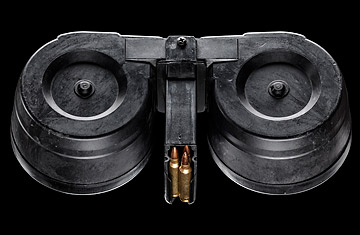
Legislators have tried to ban 100-round ammo-drum magazines similar to the one that was used in Aurora.
'We cannot and will not be passive in the face of such violence,' President Barack Obama said in January 2011, after a deranged gunman shot Congresswoman Gabrielle Giffords and 18 others, killing six. "We should be willing to challenge old assumptions in order to lessen the prospects of such violence in the future." He called for a "national conversation" about "everything from the merits of gun-safety laws to the adequacy of our mental-health system," and he asked that it be conducted with civility. It was a terrific speech, perhaps the best of his presidency. And then ... nothing.
There has been no conversation about either gun control or the mental-health system--even though mass shootings have become a plague since the late 1970s, averaging nearly 20 per year according to James Alan Fox, a professor of criminology, law and public policy at Northeastern University. These rampages mean something, but the meaning is complicated and hard to untangle. The violence has a lot to do with the state of our mental health, the increased mobility and atomization of our society, the time young men in particular spend alone staring into television and computer screens, the comic-book depiction of brutality--and yes, the availability of ever more kinetic weaponry. It is a difficult topic, but as with the conversation we're having about the nature and equity of our economy in this election year, it is all about the transition from the industrial to the information age. The remedies, if any exist, are elusive. The President was right: this was, and is, a subject that needs to be addressed in a mature and subtle way.
And so it was striking, and disappointing, that both Obama and Mitt Romney--and most of a jaded mass media--scurried away from any substantive discussion after alleged gunman James Holmes went on a murderous spree in a Colorado movie theater, shooting 70 and killing 12. Holmes had amassed an arsenal that included a semiautomatic assault rifle and 6,000 rounds of ammunition. Sales of the gun that was originally identified as the shooter's weapon of choice were prohibited during the 10-year life of the 1994 federal assault-weapons ban; they were also prohibited in Massachusetts, after the federal ban expired, by the signature of none other than Governor Romney.
Romney's delinquency on the gun-control segment of this issue is understandable, part of the chameleon turn he's made to become the nominee of a political party that counts gun-rights advocates as an essential part of its base. But what about Obama? The Democratic Party has historically been the advocate of gun control. Bill Clinton signed into law both the assault-weapons ban, which George W. Bush allowed to lapse in 2004, and the Brady Law, which required background checks of those seeking to purchase handguns. Democratic-leaning constituencies--especially minorities and the poor--remain the primary victims of gun violence. And yet the party has abandoned the gun-control debate, leaving the field to an ever more fanatic National Rifle Association (NRA). It fell to poor Jay Carney, the White House press secretary, to deliver the President's views on the subject: "He believes we need to take steps that protect Second Amendment rights of the American people but that ensure that we are not allowing weapons into the hands of individuals who should not, by existing law, obtain those weapons."